
Annotated Bibliography Planning & Review
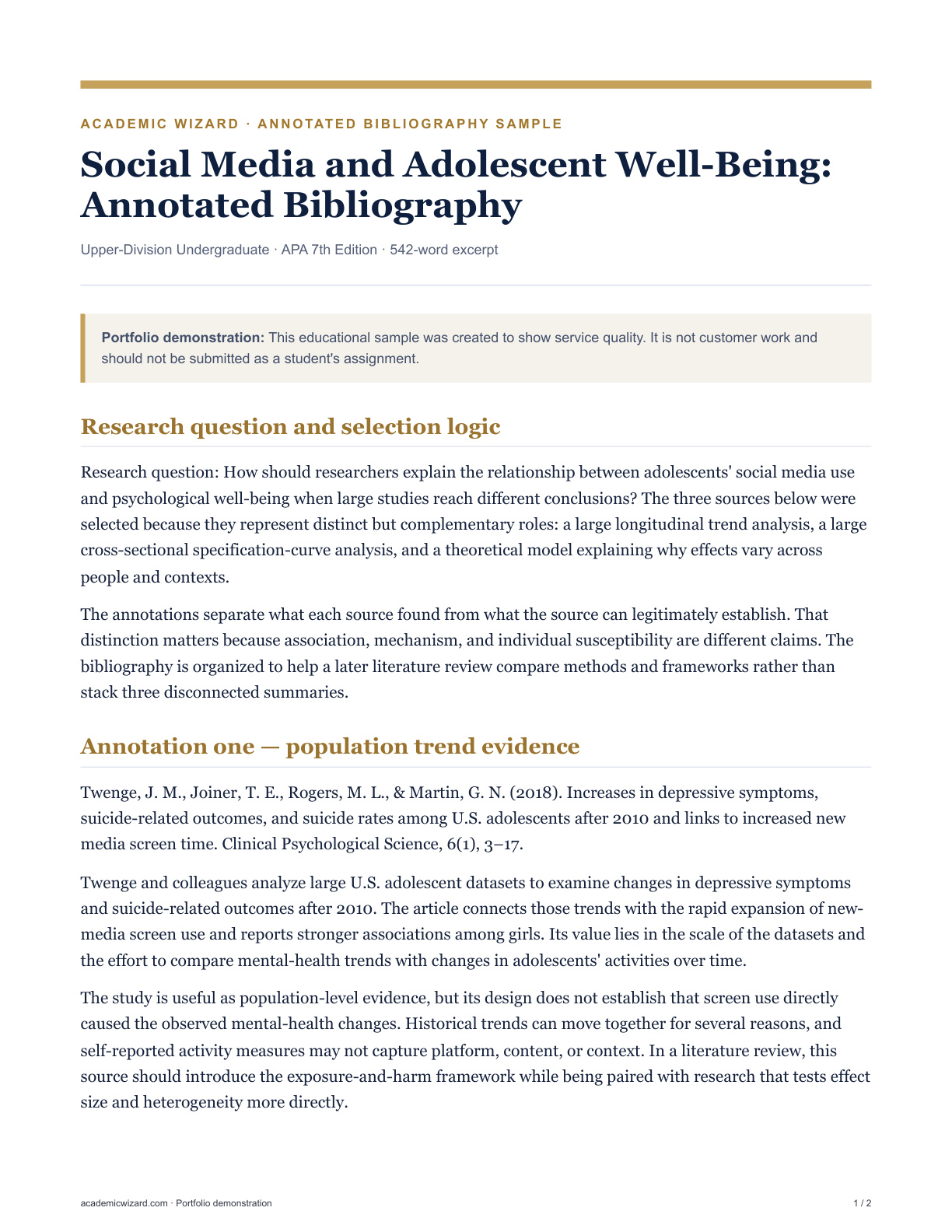
Social Media and Adolescent Well-Being: Annotated Bibliography
This sample demonstrates: Accurate source identification, concise summary, credibility and limitation analysis, and a clear explanation of how each source supports the research question.
Prepared by Academic Wizard · Hypothetical portfolio demonstration
542-word excerpt
Annotated Bibliography Planning & Review
Upper-Division Undergraduate
APA 7th Edition
Accurate source identification, concise summary, credibility and limitation analysis, and a clear explanation of how each source supports the research question.
Portfolio demonstration · Educational illustration. Hypothetical, non-client material created to demonstrate the review method. It is not a completed assignment for submission. Customer files and deliverables are never published.
Review proof
Brief, reasoning, and final quality control
Hypothetical source-review task: demonstrate APA citations and concise annotations that summarize, evaluate, and explain relevance to a research question.
- Citation completeness
- Summary accuracy
- Source evaluation
- Research relevance
- Separated what each source says from how credible and useful it is.
- Added explicit relevance statements so the bibliography supports later research planning.
- Standardized annotations so every entry answers the same core questions.
- Citation elements checked
- Summary and evaluation are distinct
- Relevance is explicit
- No claim extends beyond the cited source
Research question and selection logic
Research question: How should researchers explain the relationship between adolescents' social media use and psychological well-being when large studies reach different conclusions? The three sources below were selected because they represent distinct but complementary roles: a large longitudinal trend analysis, a large cross-sectional specification-curve analysis, and a theoretical model explaining why effects vary across people and contexts.
The annotations separate what each source found from what the source can legitimately establish. That distinction matters because association, mechanism, and individual susceptibility are different claims. The bibliography is organized to help a later literature review compare methods and frameworks rather than stack three disconnected summaries.
Annotation one — population trend evidence
Twenge, J. M., Joiner, T. E., Rogers, M. L., & Martin, G. N. (2018). Increases in depressive symptoms, suicide-related outcomes, and suicide rates among U.S. adolescents after 2010 and links to increased new media screen time. Clinical Psychological Science, 6(1), 3–17.
Twenge and colleagues analyze large U.S. adolescent datasets to examine changes in depressive symptoms and suicide-related outcomes after 2010. The article connects those trends with the rapid expansion of new-media screen use and reports stronger associations among girls. Its value lies in the scale of the datasets and the effort to compare mental-health trends with changes in adolescents' activities over time.
The study is useful as population-level evidence, but its design does not establish that screen use directly caused the observed mental-health changes. Historical trends can move together for several reasons, and self-reported activity measures may not capture platform, content, or context. In a literature review, this source should introduce the exposure-and-harm framework while being paired with research that tests effect size and heterogeneity more directly.
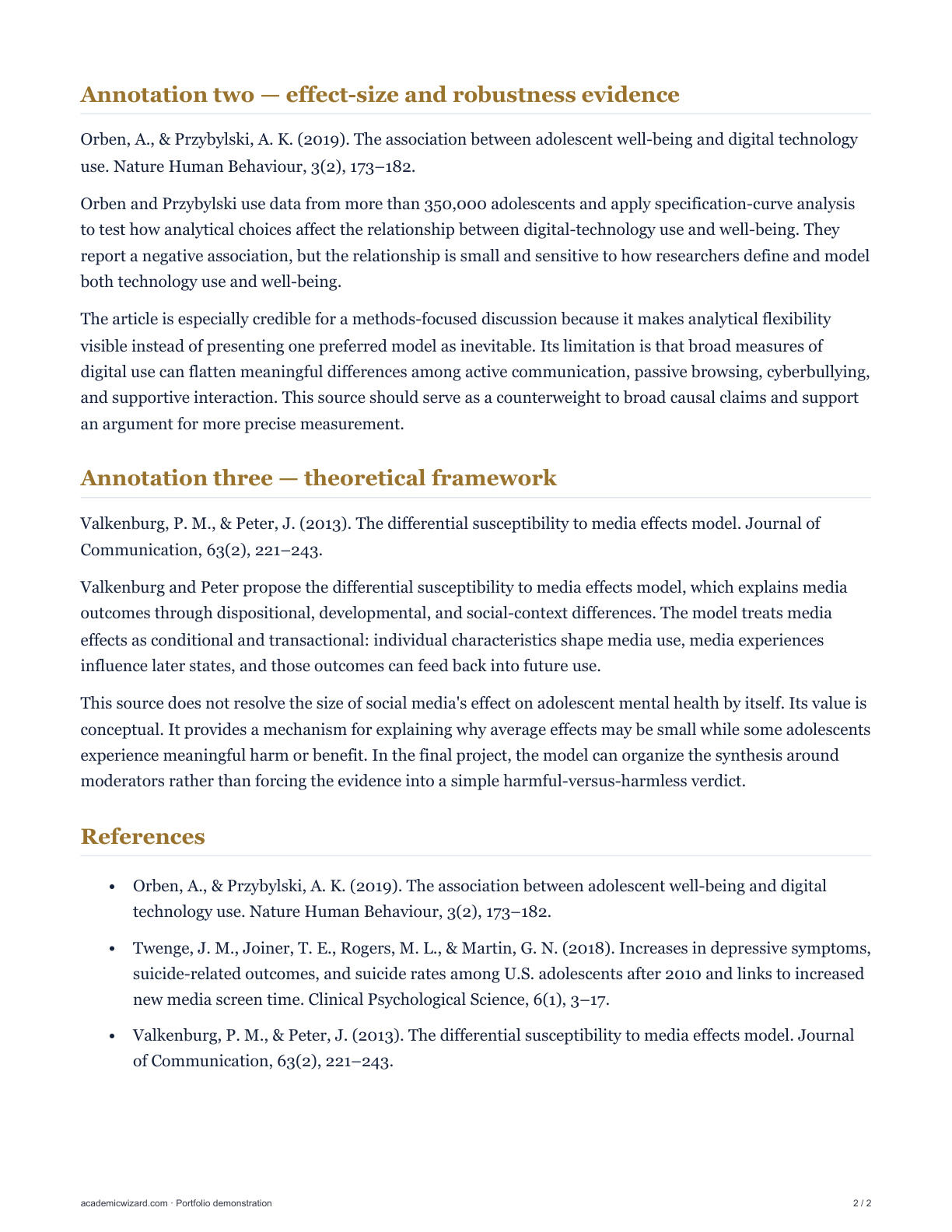
Annotation two — effect-size and robustness evidence
Orben, A., & Przybylski, A. K. (2019). The association between adolescent well-being and digital technology use. Nature Human Behaviour, 3(2), 173–182.
Orben and Przybylski use data from more than 350,000 adolescents and apply specification-curve analysis to test how analytical choices affect the relationship between digital-technology use and well-being. They report a negative association, but the relationship is small and sensitive to how researchers define and model both technology use and well-being.
The article is especially credible for a methods-focused discussion because it makes analytical flexibility visible instead of presenting one preferred model as inevitable. Its limitation is that broad measures of digital use can flatten meaningful differences among active communication, passive browsing, cyberbullying, and supportive interaction. This source should serve as a counterweight to broad causal claims and support an argument for more precise measurement.
Annotation three — theoretical framework
Valkenburg, P. M., & Peter, J. (2013). The differential susceptibility to media effects model. Journal of Communication, 63(2), 221–243.
Valkenburg and Peter propose the differential susceptibility to media effects model, which explains media outcomes through dispositional, developmental, and social-context differences. The model treats media effects as conditional and transactional: individual characteristics shape media use, media experiences influence later states, and those outcomes can feed back into future use.
This source does not resolve the size of social media's effect on adolescent mental health by itself. Its value is conceptual. It provides a mechanism for explaining why average effects may be small while some adolescents experience meaningful harm or benefit. In the final project, the model can organize the synthesis around moderators rather than forcing the evidence into a simple harmful-versus-harmless verdict.
References
- Orben, A., & Przybylski, A. K. (2019). The association between adolescent well-being and digital technology use. Nature Human Behaviour, 3(2), 173–182.
- Twenge, J. M., Joiner, T. E., Rogers, M. L., & Martin, G. N. (2018). Increases in depressive symptoms, suicide-related outcomes, and suicide rates among U.S. adolescents after 2010 and links to increased new media screen time. Clinical Psychological Science, 6(1), 3–17.
- Valkenburg, P. M., & Peter, J. (2013). The differential susceptibility to media effects model. Journal of Communication, 63(2), 221–243.
Get the Final QA Checklist
Use the same evidence-first review order demonstrated in Academic Wizard's public samples.
The requested resource is sent even if you leave optional marketing unchecked. Privacy Policy applies.
Sample questions
What this example is—and how to use it
What does this Annotated Bibliography Planning & Review sample demonstrate?
Accurate source identification, concise summary, credibility and limitation analysis, and a clear explanation of how each source supports the research question.
Is this real student or client work?
No. Academic Wizard created this hypothetical portfolio sample to demonstrate a defined service while protecting student privacy and avoiding fabricated testimonials.
Can I submit this sample as my own work?
No. Use the sample to understand structure, review scope, and deliverable quality. Your submission must remain your own work and follow your institution's rules.
Keep learning
Related service, guide, and tools
More sample deliverables
Ready when you are
Get structured support on your next assignment
Choose the defined expert service that fits your student-authored work, or use the free Assignment Control Center for planning.
Want to compare every expert option? Browse Expert Help or view pricing