
Essay Planning & Review
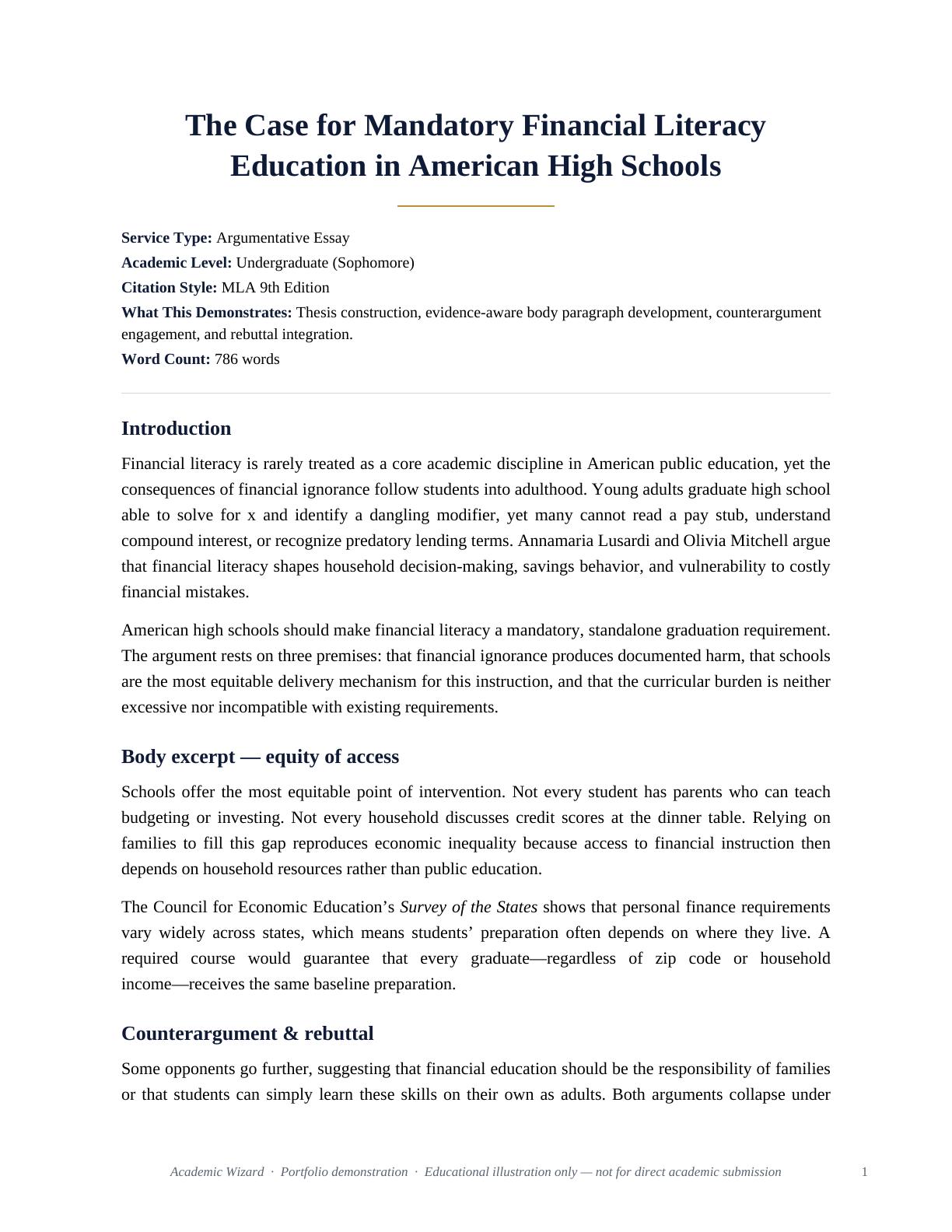
The Case for Mandatory Financial Literacy Education in American High Schools
This sample demonstrates: Thesis construction, evidence-aware body paragraph development, counterargument engagement, and rebuttal integration.
Prepared by Academic Wizard · Hypothetical portfolio demonstration
786 words
Essay Planning & Review
Undergraduate (Sophomore)
MLA 9th Edition
Thesis construction, evidence-aware body paragraph development, counterargument engagement, and rebuttal integration.
Portfolio demonstration · Educational illustration. Hypothetical, non-client material created to demonstrate the review method. It is not a completed assignment for submission. Customer files and deliverables are never published.
Review proof
Brief, reasoning, and final quality control
Hypothetical undergraduate prompt: evaluate whether U.S. high schools should require a standalone financial-literacy course and support the position in MLA style.
- Thesis precision and scope
- Evidence-to-claim alignment
- Counterargument and rebuttal structure
- MLA source integration
- Narrowed the claim to a specific graduation requirement so the argument can be tested.
- Placed the equity rationale before the rebuttal to establish the strongest affirmative case first.
- Converted broad assertions into source-linked claims and explicit reasoning.
- Student-authorship boundary stated
- Thesis answers the hypothetical prompt
- Counterargument receives a direct rebuttal
- In-text citations and Works Cited cross-checked
Introduction
Financial literacy is rarely treated as a core academic discipline in American public education, yet the consequences of financial ignorance follow students into adulthood. Young adults graduate high school able to solve for x and identify a dangling modifier, yet many cannot read a pay stub, understand compound interest, or recognize predatory lending terms. Annamaria Lusardi and Olivia Mitchell argue that financial literacy shapes household decision-making, savings behavior, and vulnerability to costly financial mistakes.
American high schools should make financial literacy a mandatory, standalone graduation requirement. The argument rests on three premises: that financial ignorance produces documented harm, that schools are the most equitable delivery mechanism for this instruction, and that the curricular burden is neither excessive nor incompatible with existing requirements.
Body excerpt — equity of access
Schools offer the most equitable point of intervention. Not every student has parents who can teach budgeting or investing. Not every household discusses credit scores at the dinner table. Relying on families to fill this gap reproduces economic inequality because access to financial instruction then depends on household resources rather than public education.
The Council for Economic Education's Survey of the States shows that personal finance requirements vary widely across states, which means students' preparation often depends on where they live. A required course would guarantee that every graduate—regardless of zip code or household income—receives the same baseline preparation.
Counterargument & rebuttal
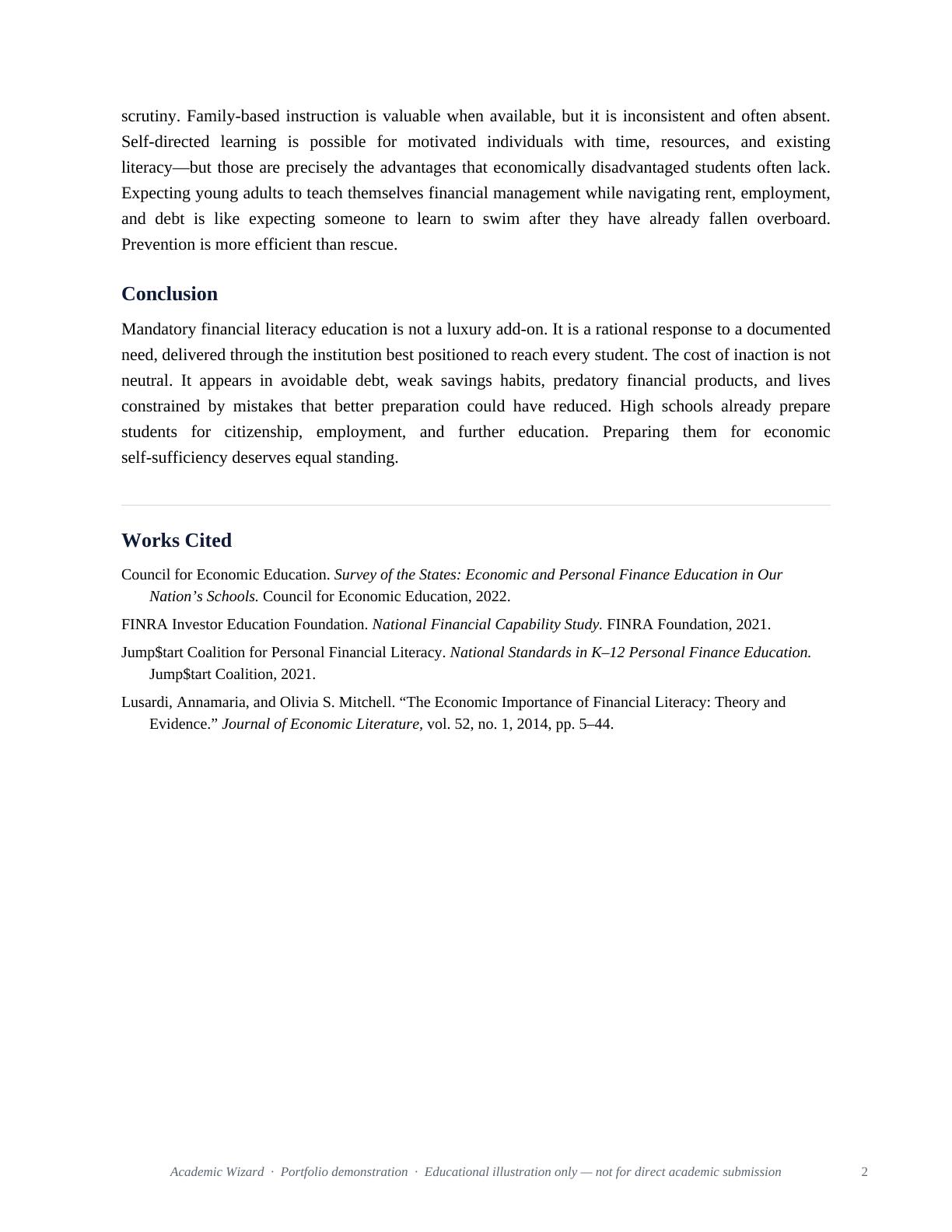
Some opponents go further, suggesting that financial education should be the responsibility of families or that students can simply learn these skills on their own as adults. Both arguments collapse under scrutiny. Family-based instruction is valuable when available, but it is inconsistent and often absent. Self-directed learning is possible for motivated individuals with time, resources, and existing literacy—but those are precisely the advantages that economically disadvantaged students often lack. Expecting young adults to teach themselves financial management while navigating rent, employment, and debt is like expecting someone to learn to swim after they have already fallen overboard. Prevention is more efficient than rescue.
Conclusion
Mandatory financial literacy education is not a luxury add-on. It is a rational response to a documented need, delivered through the institution best positioned to reach every student. The cost of inaction is not neutral. It appears in avoidable debt, weak savings habits, predatory financial products, and lives constrained by mistakes that better preparation could have reduced. High schools already prepare students for citizenship, employment, and further education. Preparing them for economic self-sufficiency deserves equal standing.
References
- Council for Economic Education. Survey of the States: Economic and Personal Finance Education in Our Nation's Schools. Council for Economic Education, 2022.
- FINRA Investor Education Foundation. National Financial Capability Study. FINRA Foundation, 2021.
- Jump$tart Coalition for Personal Financial Literacy. National Standards in K-12 Personal Finance Education. Jump$tart Coalition, 2021.
- Lusardi, Annamaria, and Olivia S. Mitchell. "The Economic Importance of Financial Literacy: Theory and Evidence." Journal of Economic Literature, vol. 52, no. 1, 2014, pp. 5–44.
Get the Final QA Checklist
Use the same evidence-first review order demonstrated in Academic Wizard's public samples.
The requested resource is sent even if you leave optional marketing unchecked. Privacy Policy applies.
Sample questions
What this example is—and how to use it
What does this Essay Planning & Review sample demonstrate?
Thesis construction, evidence-aware body paragraph development, counterargument engagement, and rebuttal integration.
Is this real student or client work?
No. Academic Wizard created this hypothetical portfolio sample to demonstrate a defined service while protecting student privacy and avoiding fabricated testimonials.
Can I submit this sample as my own work?
No. Use the sample to understand structure, review scope, and deliverable quality. Your submission must remain your own work and follow your institution's rules.
Keep learning
Related service, guide, and tools
More sample deliverables
Ready when you are
Get structured support on your next assignment
Choose the defined expert service that fits your student-authored work, or use the free Assignment Control Center for planning.
Want to compare every expert option? Browse Expert Help or view pricing