
Case Analysis Review
Reducing Missed Appointments at Northstar Community Clinic
This sample demonstrates: Case diagnosis, evidence-to-problem mapping, comparison of alternatives, implementation planning, and measurable recommendations without pretending a fictional case is real customer work.
Prepared by Academic Wizard · Hypothetical portfolio demonstration
479-word excerpt
Case Analysis Review
Undergraduate Business / Health Administration
Framework-Based Analysis
Case diagnosis, evidence-to-problem mapping, comparison of alternatives, implementation planning, and measurable recommendations without pretending a fictional case is real customer work.
Portfolio demonstration · Educational illustration. Hypothetical, non-client material created to demonstrate the review method. It is not a completed assignment for submission. Customer files and deliverables are never published.
Review proof
Brief, reasoning, and final quality control
Hypothetical MBA case review: diagnose a strategic problem, apply an analytical framework, compare alternatives, and justify a recommendation.
- Problem definition
- Framework application
- Alternative evaluation
- Recommendation logic
- Distinguished symptoms from the underlying decision problem.
- Required each alternative to use the same evaluation criteria.
- Connected the recommendation to evidence, tradeoffs, and implementation risks.
- Case facts are not invented
- Framework is applied consistently
- Alternatives include tradeoffs
- Recommendation follows from the analysis
Portfolio case notice and scenario
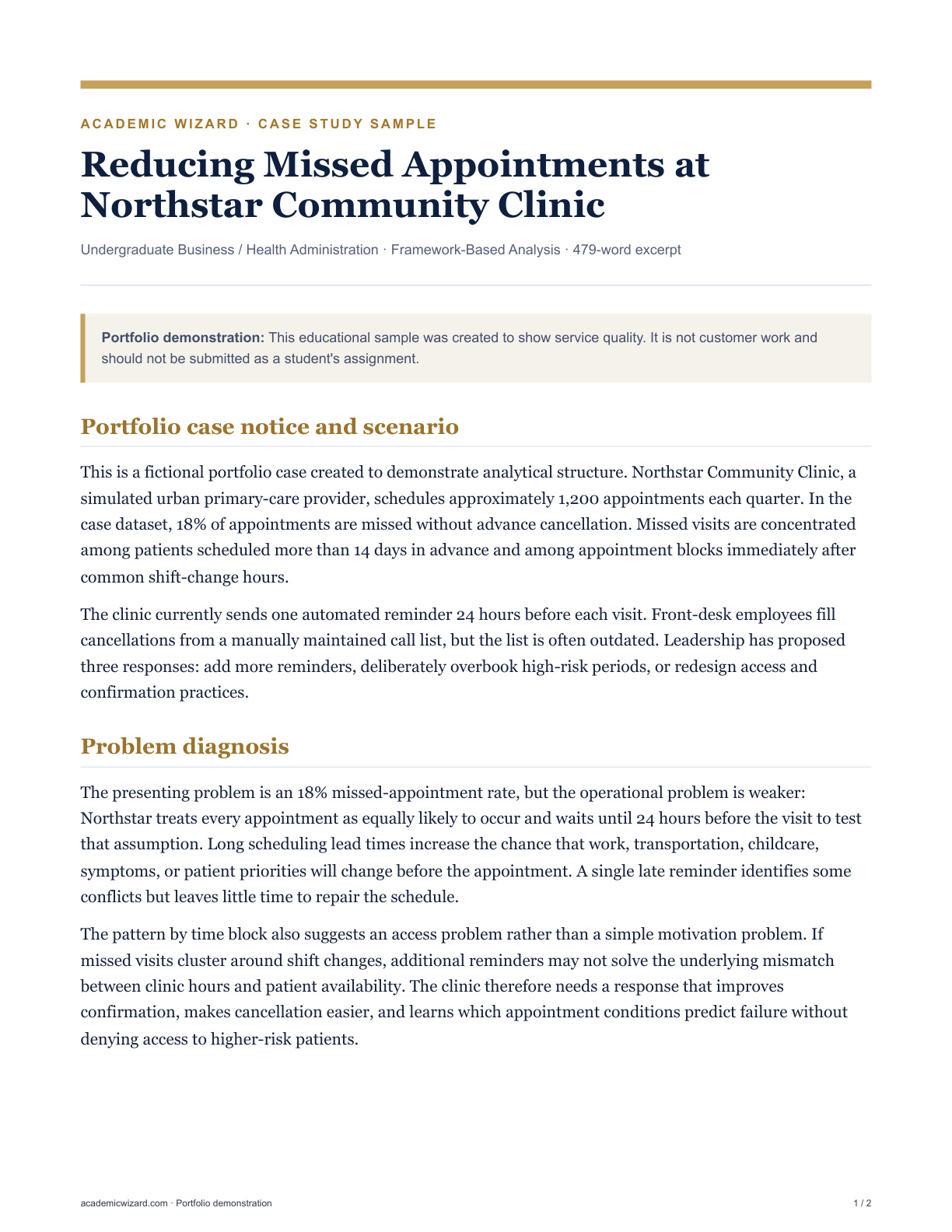
This is a fictional portfolio case created to demonstrate analytical structure. Northstar Community Clinic, a simulated urban primary-care provider, schedules approximately 1,200 appointments each quarter. In the case dataset, 18% of appointments are missed without advance cancellation. Missed visits are concentrated among patients scheduled more than 14 days in advance and among appointment blocks immediately after common shift-change hours.
The clinic currently sends one automated reminder 24 hours before each visit. Front-desk employees fill cancellations from a manually maintained call list, but the list is often outdated. Leadership has proposed three responses: add more reminders, deliberately overbook high-risk periods, or redesign access and confirmation practices.
Problem diagnosis
The presenting problem is an 18% missed-appointment rate, but the operational problem is weaker: Northstar treats every appointment as equally likely to occur and waits until 24 hours before the visit to test that assumption. Long scheduling lead times increase the chance that work, transportation, childcare, symptoms, or patient priorities will change before the appointment. A single late reminder identifies some conflicts but leaves little time to repair the schedule.
The pattern by time block also suggests an access problem rather than a simple motivation problem. If missed visits cluster around shift changes, additional reminders may not solve the underlying mismatch between clinic hours and patient availability. The clinic therefore needs a response that improves confirmation, makes cancellation easier, and learns which appointment conditions predict failure without denying access to higher-risk patients.
Alternatives
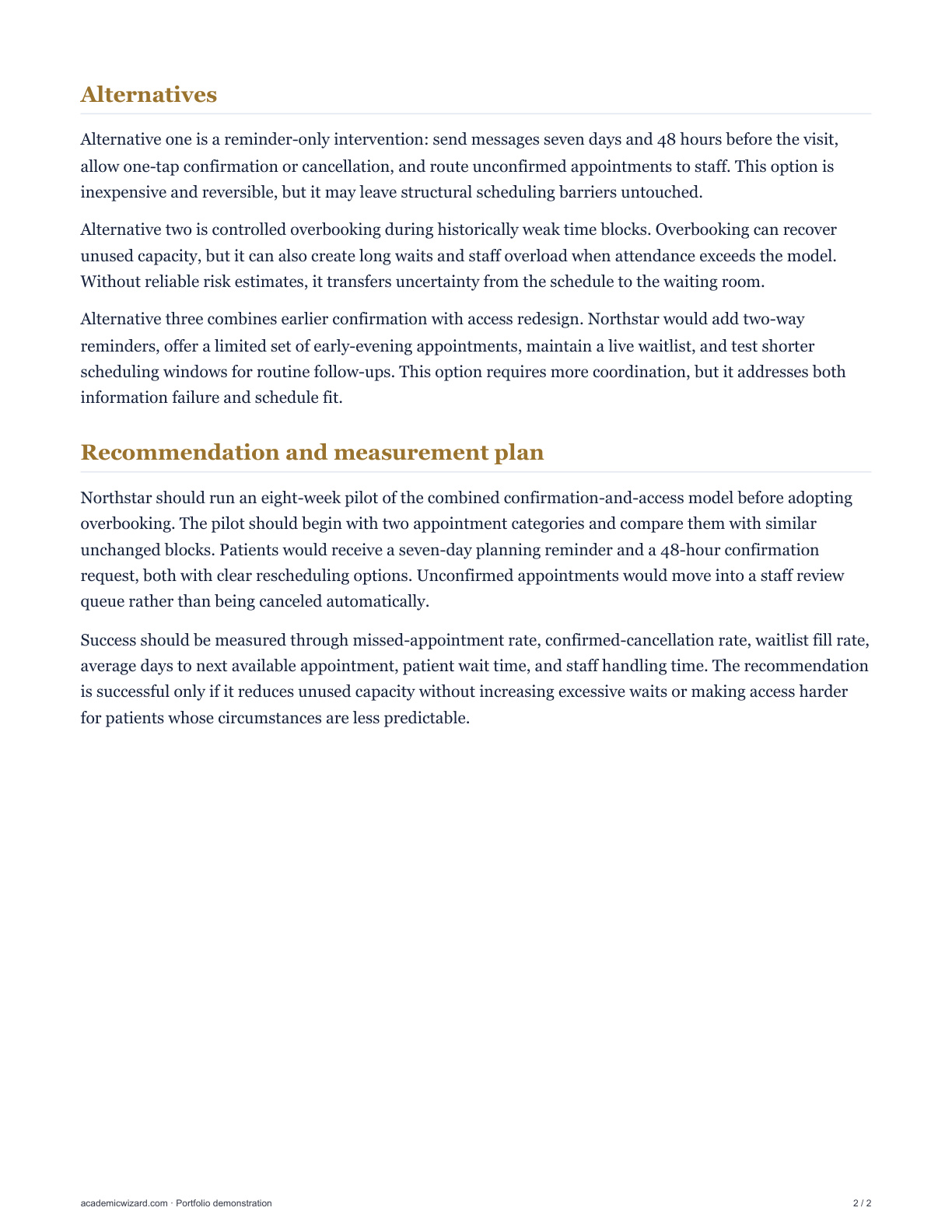
Alternative one is a reminder-only intervention: send messages seven days and 48 hours before the visit, allow one-tap confirmation or cancellation, and route unconfirmed appointments to staff. This option is inexpensive and reversible, but it may leave structural scheduling barriers untouched.
Alternative two is controlled overbooking during historically weak time blocks. Overbooking can recover unused capacity, but it can also create long waits and staff overload when attendance exceeds the model. Without reliable risk estimates, it transfers uncertainty from the schedule to the waiting room.
Alternative three combines earlier confirmation with access redesign. Northstar would add two-way reminders, offer a limited set of early-evening appointments, maintain a live waitlist, and test shorter scheduling windows for routine follow-ups. This option requires more coordination, but it addresses both information failure and schedule fit.
Recommendation and measurement plan
Northstar should run an eight-week pilot of the combined confirmation-and-access model before adopting overbooking. The pilot should begin with two appointment categories and compare them with similar unchanged blocks. Patients would receive a seven-day planning reminder and a 48-hour confirmation request, both with clear rescheduling options. Unconfirmed appointments would move into a staff review queue rather than being canceled automatically.
Success should be measured through missed-appointment rate, confirmed-cancellation rate, waitlist fill rate, average days to next available appointment, patient wait time, and staff handling time. The recommendation is successful only if it reduces unused capacity without increasing excessive waits or making access harder for patients whose circumstances are less predictable.
Get the Final QA Checklist
Use the same evidence-first review order demonstrated in Academic Wizard's public samples.
The requested resource is sent even if you leave optional marketing unchecked. Privacy Policy applies.
Sample questions
What this example is—and how to use it
What does this Case Analysis Review sample demonstrate?
Case diagnosis, evidence-to-problem mapping, comparison of alternatives, implementation planning, and measurable recommendations without pretending a fictional case is real customer work.
Is this real student or client work?
No. Academic Wizard created this hypothetical portfolio sample to demonstrate a defined service while protecting student privacy and avoiding fabricated testimonials.
Can I submit this sample as my own work?
No. Use the sample to understand structure, review scope, and deliverable quality. Your submission must remain your own work and follow your institution's rules.
Keep learning
Related service, guide, and tools
More sample deliverables
Ready when you are
Get structured support on your next assignment
Choose the defined expert service that fits your student-authored work, or use the free Assignment Control Center for planning.
Want to compare every expert option? Browse Expert Help or view pricing