Deep Edit + Structure Review
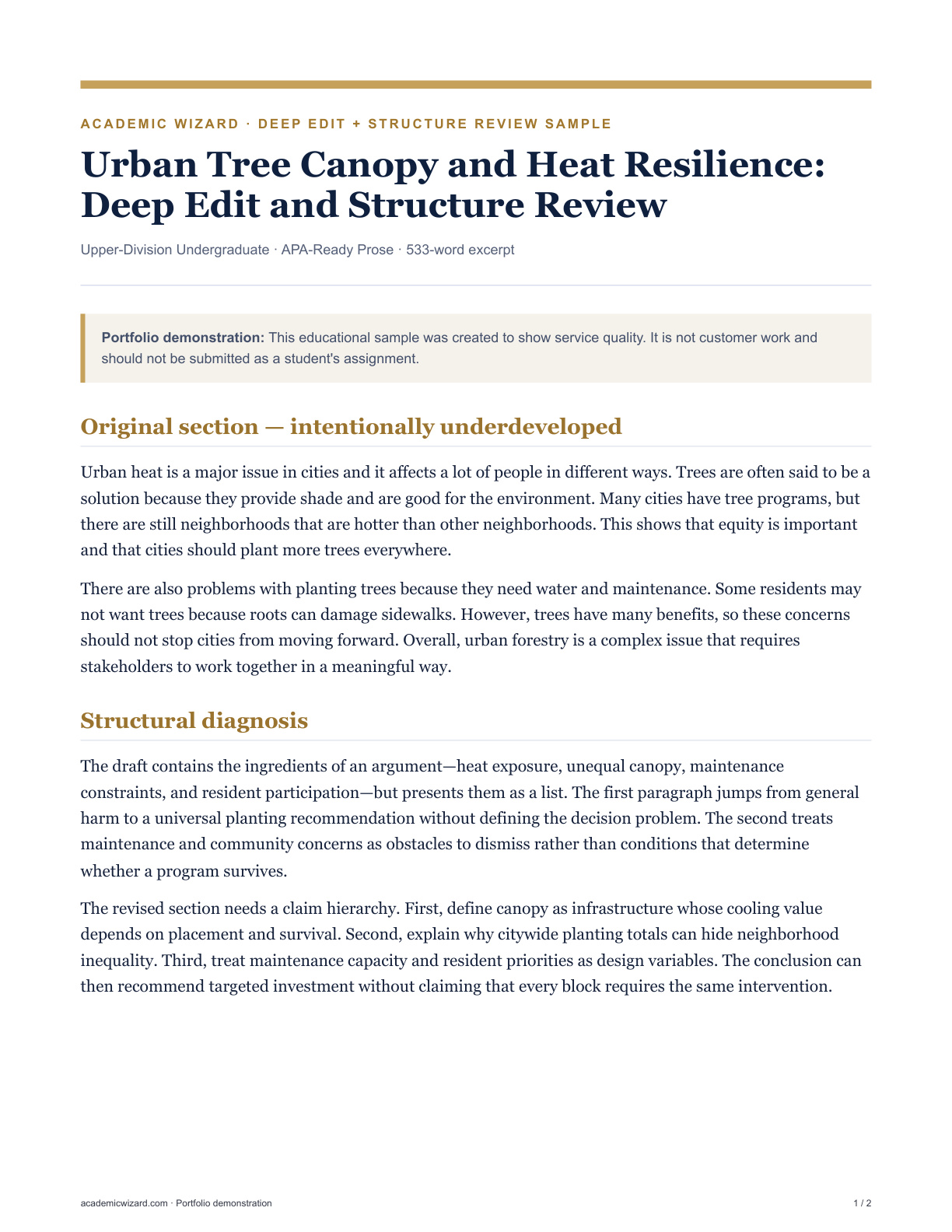
Urban Tree Canopy and Heat Resilience: Deep Edit and Structure Review
533-word excerpt
Deep Edit + Structure Review
Upper-Division Undergraduate
APA-Ready Prose
Paragraph-level restructuring, claim hierarchy, removal of vague language, preservation of author intent, and an editorial memo that explains rather than conceals major changes.
Portfolio demonstration · Educational illustration. Not intended for direct academic submission. Original work for clients is never published or shared.
Original section — intentionally underdeveloped
Urban heat is a major issue in cities and it affects a lot of people in different ways. Trees are often said to be a solution because they provide shade and are good for the environment. Many cities have tree programs, but there are still neighborhoods that are hotter than other neighborhoods. This shows that equity is important and that cities should plant more trees everywhere.
There are also problems with planting trees because they need water and maintenance. Some residents may not want trees because roots can damage sidewalks. However, trees have many benefits, so these concerns should not stop cities from moving forward. Overall, urban forestry is a complex issue that requires stakeholders to work together in a meaningful way.
Structural diagnosis
The draft contains the ingredients of an argument—heat exposure, unequal canopy, maintenance constraints, and resident participation—but presents them as a list. The first paragraph jumps from general harm to a universal planting recommendation without defining the decision problem. The second treats maintenance and community concerns as obstacles to dismiss rather than conditions that determine whether a program survives.
The revised section needs a claim hierarchy. First, define canopy as infrastructure whose cooling value depends on placement and survival. Second, explain why citywide planting totals can hide neighborhood inequality. Third, treat maintenance capacity and resident priorities as design variables. The conclusion can then recommend targeted investment without claiming that every block requires the same intervention.
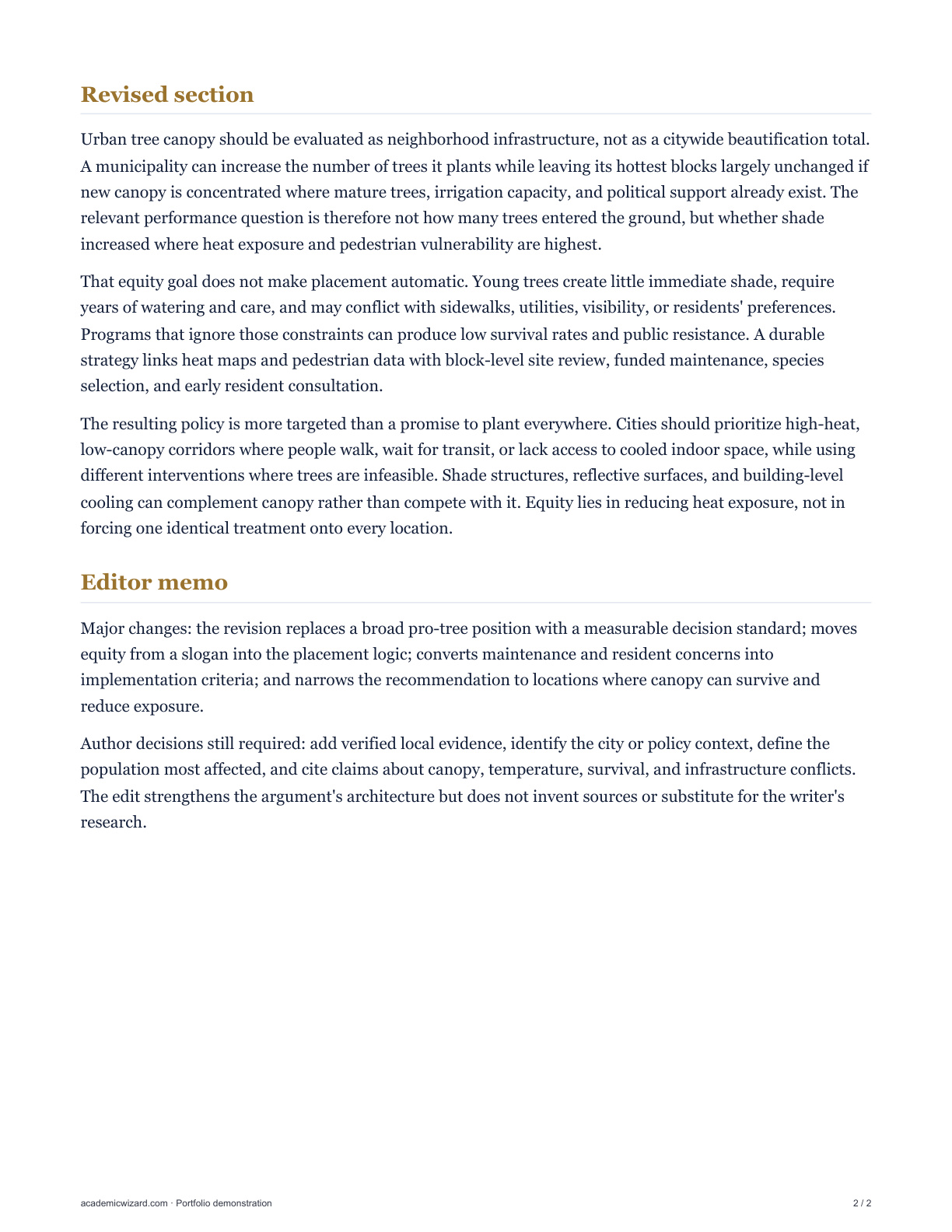
Revised section
Urban tree canopy should be evaluated as neighborhood infrastructure, not as a citywide beautification total. A municipality can increase the number of trees it plants while leaving its hottest blocks largely unchanged if new canopy is concentrated where mature trees, irrigation capacity, and political support already exist. The relevant performance question is therefore not how many trees entered the ground, but whether shade increased where heat exposure and pedestrian vulnerability are highest.
That equity goal does not make placement automatic. Young trees create little immediate shade, require years of watering and care, and may conflict with sidewalks, utilities, visibility, or residents' preferences. Programs that ignore those constraints can produce low survival rates and public resistance. A durable strategy links heat maps and pedestrian data with block-level site review, funded maintenance, species selection, and early resident consultation.
The resulting policy is more targeted than a promise to plant everywhere. Cities should prioritize high-heat, low-canopy corridors where people walk, wait for transit, or lack access to cooled indoor space, while using different interventions where trees are infeasible. Shade structures, reflective surfaces, and building-level cooling can complement canopy rather than compete with it. Equity lies in reducing heat exposure, not in forcing one identical treatment onto every location.
Editor memo
Major changes: the revision replaces a broad pro-tree position with a measurable decision standard; moves equity from a slogan into the placement logic; converts maintenance and resident concerns into implementation criteria; and narrows the recommendation to locations where canopy can survive and reduce exposure.
Author decisions still required: add verified local evidence, identify the city or policy context, define the population most affected, and cite claims about canopy, temperature, survival, and infrastructure conflicts. The edit strengthens the argument's architecture but does not invent sources or substitute for the writer's research.
Ready when you are
Get structured support on your next assignment
Samples shown are portfolio demonstrations and reference materials. Choose a service, configure your order, and check out securely.