
Academic Editing
Editing Sample: Before and After — Professional Academic Tone Revision
This sample demonstrates: Sentence-level editing that removes generic phrasing, clarifies vague references, improves flow, and preserves the student's existing ideas without adding new claims or evidence.
Prepared by Academic Wizard · Hypothetical portfolio demonstration
Before-and-after demonstration
Academic Editing
Upper-Division Undergraduate
MLA 9th Edition
Sentence-level editing that removes generic phrasing, clarifies vague references, improves flow, and preserves the student's existing ideas without adding new claims or evidence.
Portfolio demonstration · Educational illustration. Hypothetical, non-client material created to demonstrate the review method. It is not a completed assignment for submission. Customer files and deliverables are never published.
Flagship service walkthrough
From a common student need to a usable next step
Follow this illustrative, non-client example to see what Academic Editing evaluates, what the evidence looks like, and what the defined deliverable contains.
A student has written the draft and developed the ideas, but vague attribution, repetitive language, and awkward sentences are hiding the argument.
An intentionally flawed undergraduate paragraph containing stock phrases, unsupported consensus language, unclear references, and repeated descriptions of the same change.
Academic Editing works line by line to improve grammar, clarity, concision, flow, tone, and citation consistency while keeping changes visible and preserving the student's meaning.
An edited student-authored file with visible changes plus a short review note explaining recurring patterns and the most important recommendations.
- The original and revised paragraphs appear together for direct comparison.
- Diagnostic notes identify generic attribution, filler, repetition, and vague references before any revision is shown.
- The revision rationale explains what changed, why it changed, and which ideas or evidence were deliberately not added.
The student's topic, concern, and argument remain intact. No theory, statistic, source, or policy position is added, and the student reviews the visible changes.
Review proof
Brief, reasoning, and final quality control
Hypothetical undergraduate draft requiring sentence-level editing for clarity, concision, academic tone, and flow without adding new argument content.
- Sentence-level clarity
- Vague attribution
- Referent clarity and flow
- Tone and evidence boundaries
- Removed generic opening language and stock phrasing without changing the student's topic.
- Clarified who the original stakeholder reference described while preserving the existing concern about workplace change.
- Flagged unsupported consensus claims instead of inventing sources, theories, or policy recommendations.
- Meaning preserved
- Major changes explained
- Unsupported claims flagged
- No new concepts or evidence added
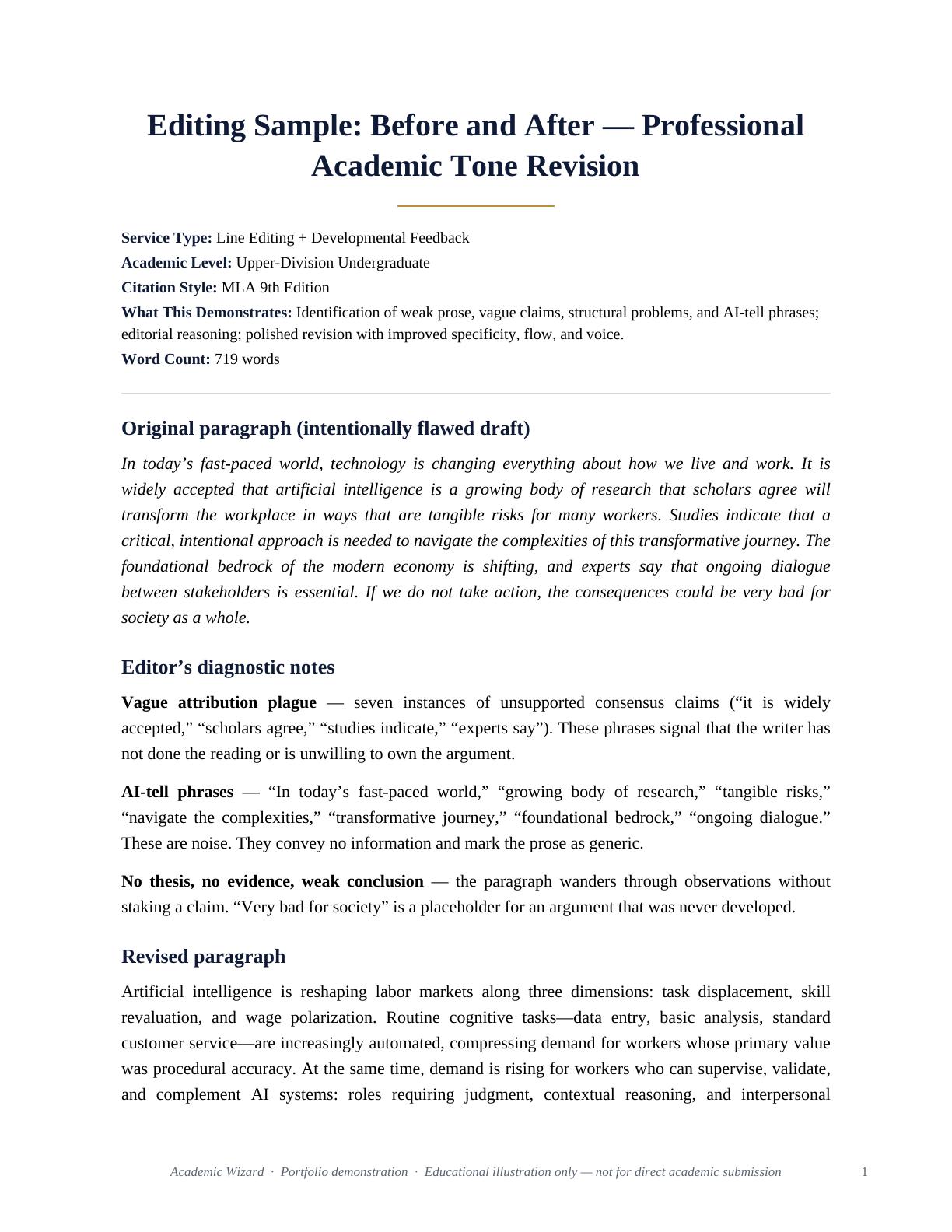
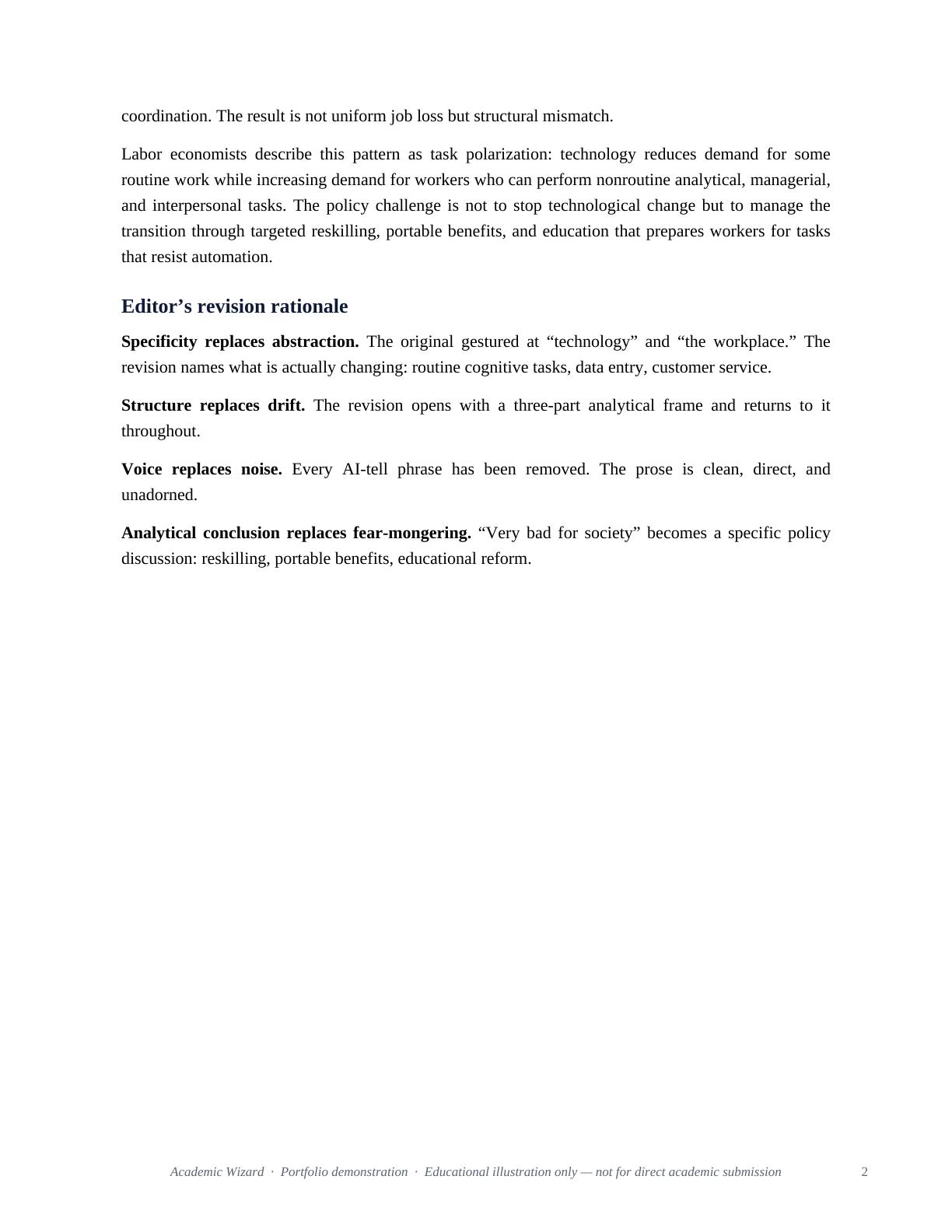
Original paragraph (intentionally flawed draft)
In today's fast-paced world, technology is changing everything about how we live and work. It is widely accepted that artificial intelligence is a growing body of research that scholars agree will transform the workplace in ways that are tangible risks for many workers. Studies indicate that a critical, intentional approach is needed to navigate the complexities of this transformative journey. The foundational bedrock of the modern economy is shifting, and experts say that ongoing dialogue between stakeholders is essential. If we do not take action, the consequences could be very bad for society as a whole.
Editor's diagnostic notes
Generic attribution — phrases such as "it is widely accepted," "scholars agree," "studies indicate," and "experts say" imply evidence without identifying it. Academic Editing can flag these claims, but the student must supply or remove the supporting sources.
Stock phrasing — "In today's fast-paced world," "navigate the complexities," "transformative journey," and "foundational bedrock" add length without adding meaning. The edit replaces them with direct language already supported by the paragraph.
Repetition and vague references — the paragraph repeats the idea of change without clearly identifying who should respond. The line edit can clarify that "stakeholders" refers to employers, policymakers, and workers while leaving the underlying argument unchanged.
Revised paragraph
Artificial intelligence is changing how people live and work, particularly in the workplace. This shift may create meaningful risks for workers, so employers, policymakers, and workers need a deliberate response. Continued dialogue can help these groups evaluate the effects of workplace automation, communicate their concerns, and plan for the transition. Without coordinated action, the economic and social consequences may become harder to manage.
Editor's revision rationale
Direct language replaces filler. The revised paragraph removes stock phrases and duplicated descriptions of change while preserving the original topic and concern.
Clear references replace vague labels. "Stakeholders" is clarified as employers, policymakers, and workers without introducing a new theory or policy position.
Flow improves at the sentence level. The paragraph now moves from the change, to the affected group, to the need for coordination, and then to the consequence of inaction.
Scope remains controlled. The edit adds no labor-market theory, statistics, policy program, or outside evidence. Developing a new argument or adding substantive concepts would require the student's revision or Developmental Academic Editing.
Get the Final QA Checklist
Use the same evidence-first review order demonstrated in Academic Wizard's public samples.
The requested resource is sent even if you leave optional marketing unchecked. Privacy Policy applies.
Sample questions
What this example is—and how to use it
What does this Academic Editing sample demonstrate?
Sentence-level editing that removes generic phrasing, clarifies vague references, improves flow, and preserves the student's existing ideas without adding new claims or evidence.
Is this real student or client work?
No. Academic Wizard created this hypothetical portfolio sample to demonstrate a defined service while protecting student privacy and avoiding fabricated testimonials.
Can I submit this sample as my own work?
No. Use the sample to understand structure, review scope, and deliverable quality. Your submission must remain your own work and follow your institution's rules.
Keep learning
Related service, guide, and tools
More sample deliverables
Ready when you are
Get structured support on your next assignment
Choose the defined expert service that fits your student-authored work, or use the free Assignment Control Center for planning.
Want to compare every expert option? Browse Expert Help or view pricing