
Literature Review Mapping & Editing
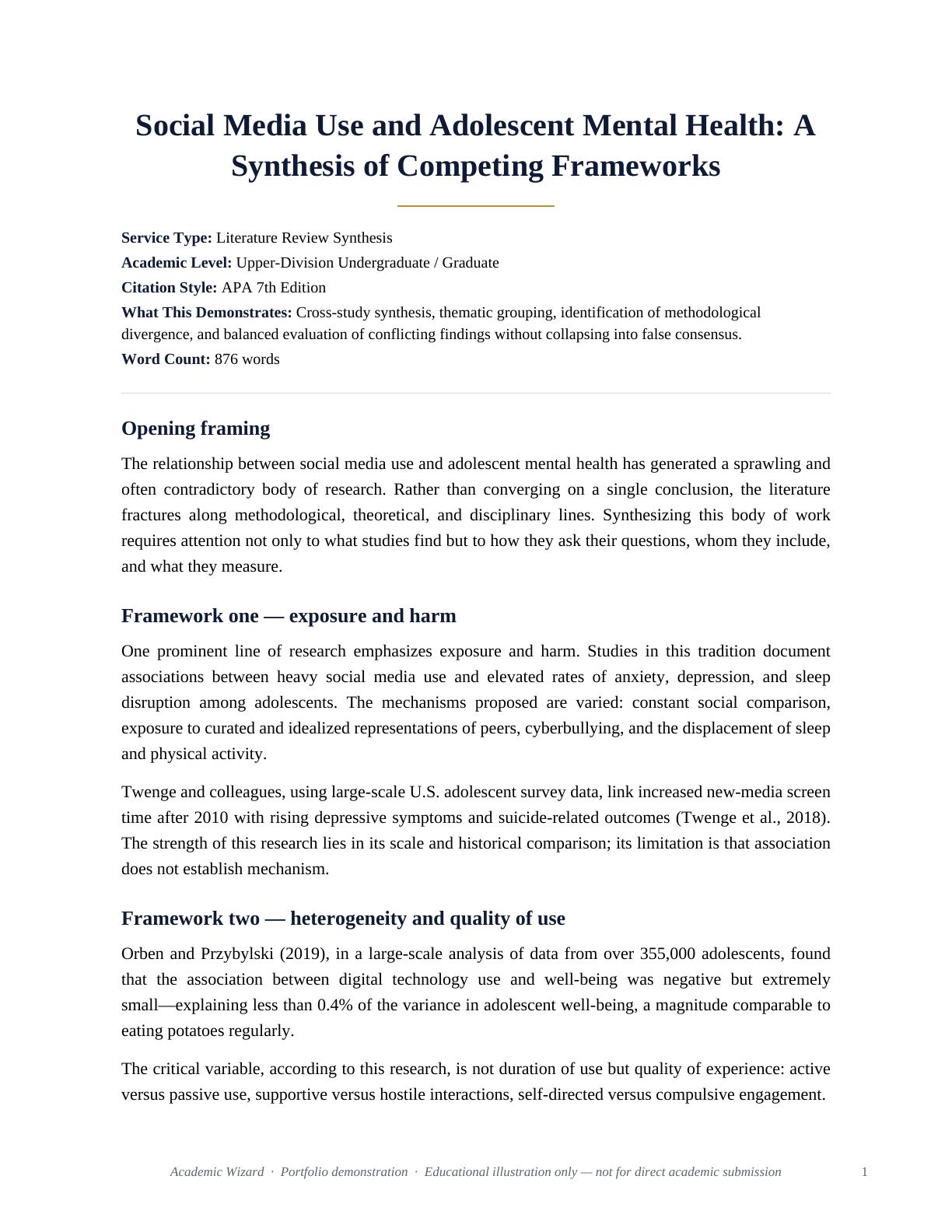
Social Media Use and Adolescent Mental Health: A Synthesis of Competing Frameworks
This sample demonstrates: Cross-study synthesis, thematic grouping, identification of methodological divergence, and balanced evaluation of conflicting findings without collapsing into false consensus.
Prepared by Academic Wizard · Hypothetical portfolio demonstration
876 words
Literature Review Mapping & Editing
Upper-Division Undergraduate / Graduate
APA 7th Edition
Cross-study synthesis, thematic grouping, identification of methodological divergence, and balanced evaluation of conflicting findings without collapsing into false consensus.
Portfolio demonstration · Educational illustration. Hypothetical, non-client material created to demonstrate the review method. It is not a completed assignment for submission. Customer files and deliverables are never published.
Review proof
Brief, reasoning, and final quality control
Hypothetical psychology review: map competing explanations for the relationship between adolescent social-media use and mental health.
- Theme-based organization
- Comparison across studies
- Causal-language restraint
- APA reference consistency
- Organized research by explanatory framework instead of summarizing one source at a time.
- Added qualifying language where observational evidence cannot support causation.
- Closed with unresolved tensions to show synthesis rather than a forced verdict.
- Each source serves a synthesis theme
- Conflicting findings are represented
- Causal claims are appropriately qualified
- References and in-text citations reconciled
Opening framing
The relationship between social media use and adolescent mental health has generated a sprawling and often contradictory body of research. Rather than converging on a single conclusion, the literature fractures along methodological, theoretical, and disciplinary lines. Synthesizing this body of work requires attention not only to what studies find but to how they ask their questions, whom they include, and what they measure.
Framework one — exposure and harm
One prominent line of research emphasizes exposure and harm. Studies in this tradition document associations between heavy social media use and elevated rates of anxiety, depression, and sleep disruption among adolescents. The mechanisms proposed are varied: constant social comparison, exposure to curated and idealized representations of peers, cyberbullying, and the displacement of sleep and physical activity.
Twenge and colleagues, using large-scale U.S. adolescent survey data, link increased new-media screen time after 2010 with rising depressive symptoms and suicide-related outcomes (Twenge et al., 2018). The strength of this research lies in its scale and historical comparison; its limitation is that association does not establish mechanism.
Framework two — heterogeneity and quality of use
Orben and Przybylski (2019), in a large-scale analysis of data from over 355,000 adolescents, found that the association between digital technology use and well-being was negative but extremely small—explaining less than 0.4% of the variance in adolescent well-being, a magnitude comparable to eating potatoes regularly.
The critical variable, according to this research, is not duration of use but quality of experience: active versus passive use, supportive versus hostile interactions, self-directed versus compulsive engagement.
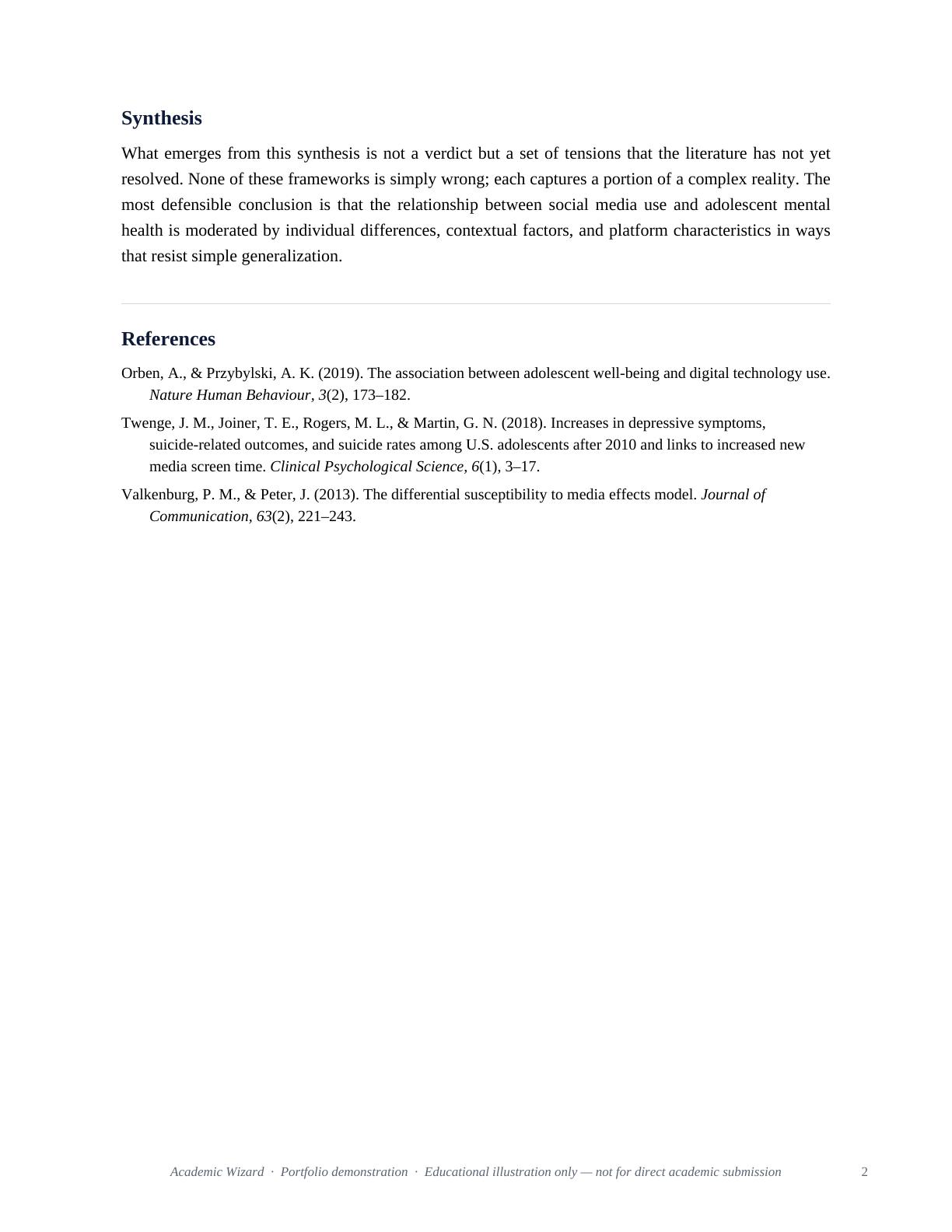
Synthesis
What emerges from this synthesis is not a verdict but a set of tensions that the literature has not yet resolved. None of these frameworks is simply wrong; each captures a portion of a complex reality. The most defensible conclusion is that the relationship between social media use and adolescent mental health is moderated by individual differences, contextual factors, and platform characteristics in ways that resist simple generalization.
References
- Orben, A., & Przybylski, A. K. (2019). The association between adolescent well-being and digital technology use. Nature Human Behaviour, 3(2), 173–182.
- Twenge, J. M., Joiner, T. E., Rogers, M. L., & Martin, G. N. (2018). Increases in depressive symptoms, suicide-related outcomes, and suicide rates among U.S. adolescents after 2010 and links to increased new media screen time. Clinical Psychological Science, 6(1), 3–17.
- Valkenburg, P. M., & Peter, J. (2013). The differential susceptibility to media effects model. Journal of Communication, 63(2), 221–243.
Get the Final QA Checklist
Use the same evidence-first review order demonstrated in Academic Wizard's public samples.
The requested resource is sent even if you leave optional marketing unchecked. Privacy Policy applies.
Sample questions
What this example is—and how to use it
What does this Literature Review Mapping & Editing sample demonstrate?
Cross-study synthesis, thematic grouping, identification of methodological divergence, and balanced evaluation of conflicting findings without collapsing into false consensus.
Is this real student or client work?
No. Academic Wizard created this hypothetical portfolio sample to demonstrate a defined service while protecting student privacy and avoiding fabricated testimonials.
Can I submit this sample as my own work?
No. Use the sample to understand structure, review scope, and deliverable quality. Your submission must remain your own work and follow your institution's rules.
Keep learning
Related service, guide, and tools
More sample deliverables
Ready when you are
Get structured support on your next assignment
Choose the defined expert service that fits your student-authored work, or use the free Assignment Control Center for planning.
Want to compare every expert option? Browse Expert Help or view pricing