
Lab Report Review
Light Exposure and Radish Seedling Growth: Lab Report Review
This sample demonstrates: Integrity-safe review using a simulated classroom dataset: results wording, separation of observation from interpretation, limitation analysis, and correction of unsupported causal claims.
Prepared by Academic Wizard · Hypothetical portfolio demonstration
418-word excerpt
Lab Report Review
Undergraduate Introductory Biology
Scientific Report Style
Integrity-safe review using a simulated classroom dataset: results wording, separation of observation from interpretation, limitation analysis, and correction of unsupported causal claims.
Portfolio demonstration · Educational illustration. Hypothetical, non-client material created to demonstrate the review method. It is not a completed assignment for submission. Customer files and deliverables are never published.
Review proof
Brief, reasoning, and final quality control
Hypothetical lab-report review: check the separation of method, results, and discussion while improving statistical clarity and scientific tone.
- Section-purpose boundaries
- Results reporting
- Interpretation restraint
- Table and citation consistency
- Moved interpretation out of Results and into Discussion.
- Replaced causal wording with language supported by the hypothetical design.
- Made variables and reported statistics explicit so the analysis can be followed.
- Methods are reproducible from the description
- Results do not overinterpret
- Discussion acknowledges limitations
- Tables and text agree
Simulation notice and report context
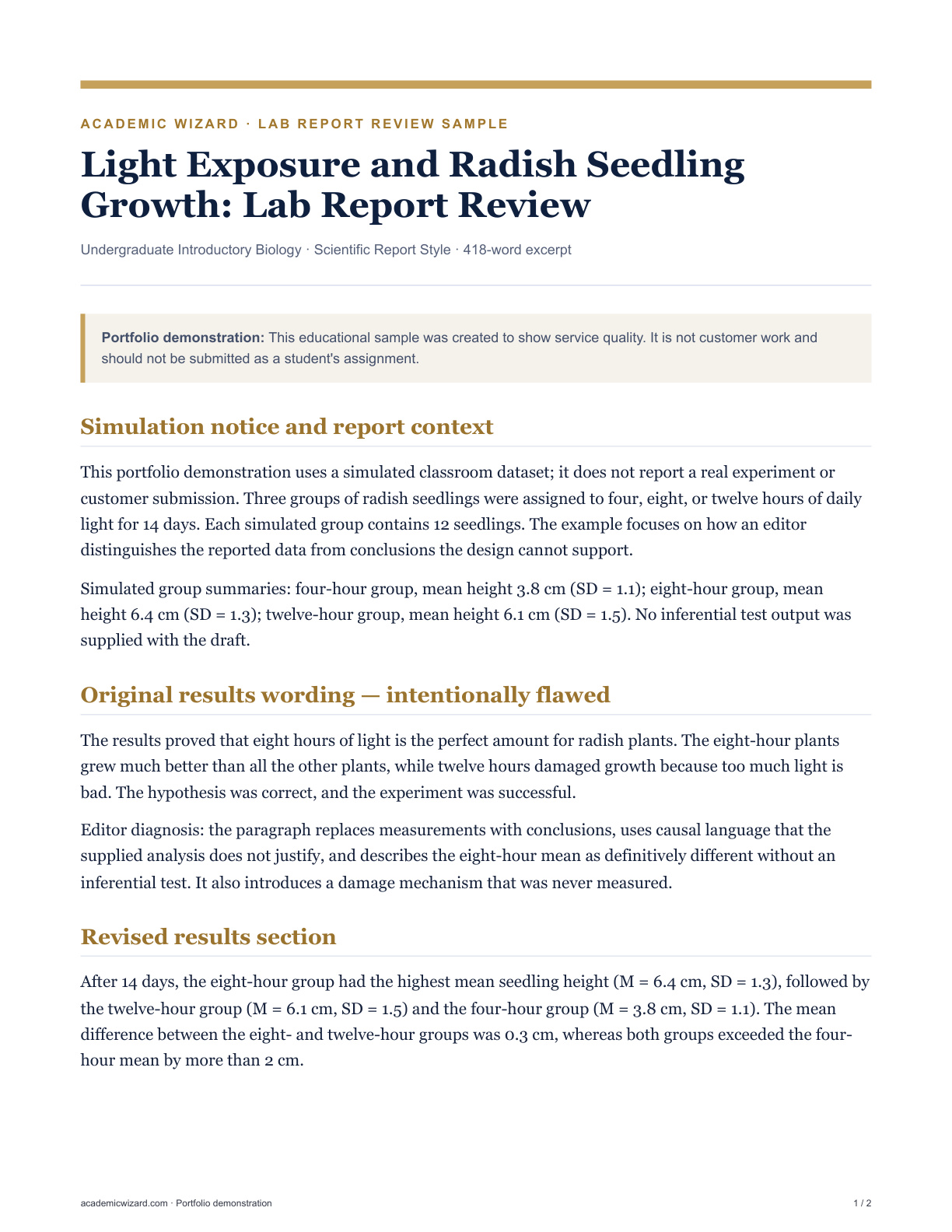
This portfolio demonstration uses a simulated classroom dataset; it does not report a real experiment or customer submission. Three groups of radish seedlings were assigned to four, eight, or twelve hours of daily light for 14 days. Each simulated group contains 12 seedlings. The example focuses on how an editor distinguishes the reported data from conclusions the design cannot support.
Simulated group summaries: four-hour group, mean height 3.8 cm (SD = 1.1); eight-hour group, mean height 6.4 cm (SD = 1.3); twelve-hour group, mean height 6.1 cm (SD = 1.5). No inferential test output was supplied with the draft.
Original results wording — intentionally flawed
The results proved that eight hours of light is the perfect amount for radish plants. The eight-hour plants grew much better than all the other plants, while twelve hours damaged growth because too much light is bad. The hypothesis was correct, and the experiment was successful.
Editor diagnosis: the paragraph replaces measurements with conclusions, uses causal language that the supplied analysis does not justify, and describes the eight-hour mean as definitively different without an inferential test. It also introduces a damage mechanism that was never measured.
Revised results section
After 14 days, the eight-hour group had the highest mean seedling height (M = 6.4 cm, SD = 1.3), followed by the twelve-hour group (M = 6.1 cm, SD = 1.5) and the four-hour group (M = 3.8 cm, SD = 1.1). The mean difference between the eight- and twelve-hour groups was 0.3 cm, whereas both groups exceeded the four-hour mean by more than 2 cm.
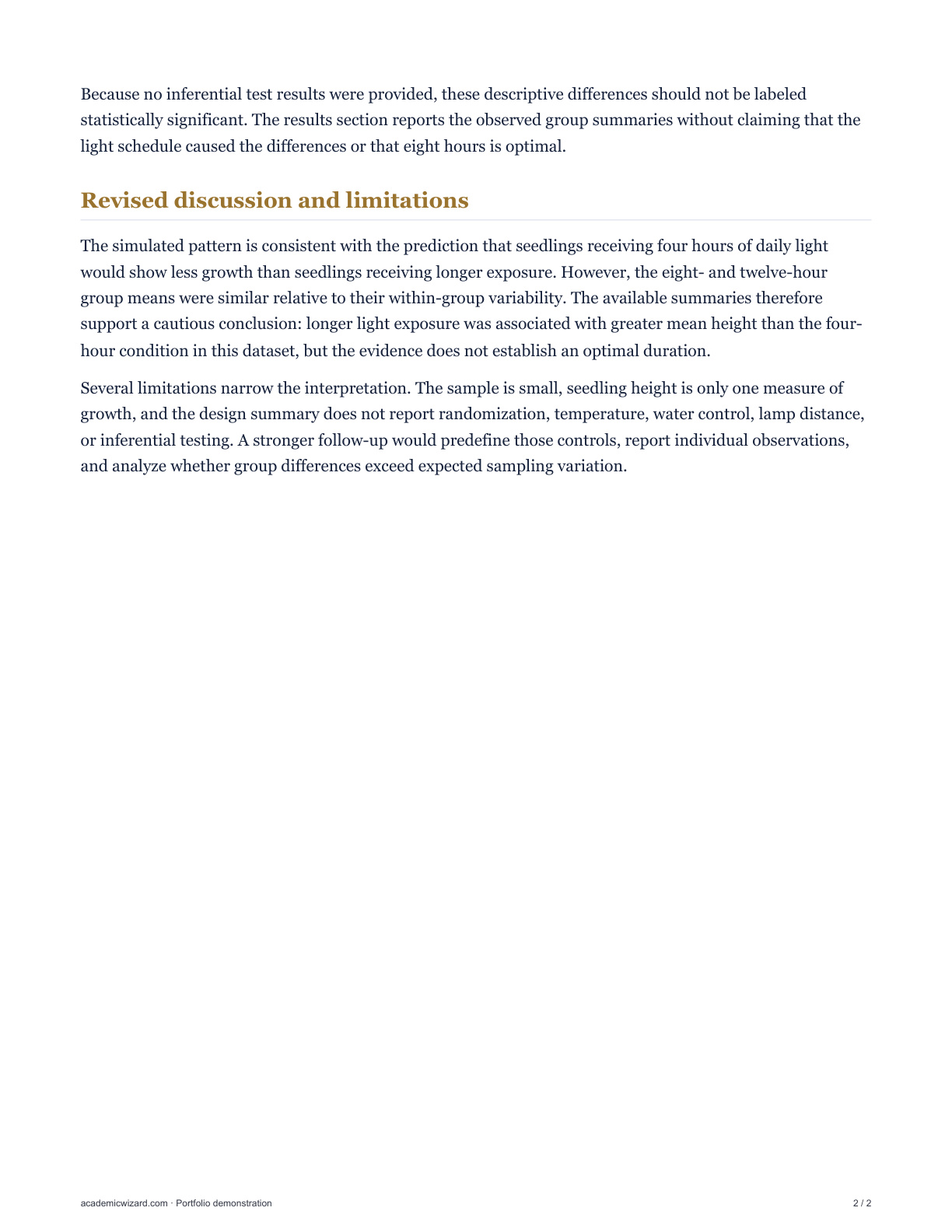
Because no inferential test results were provided, these descriptive differences should not be labeled statistically significant. The results section reports the observed group summaries without claiming that the light schedule caused the differences or that eight hours is optimal.
Revised discussion and limitations
The simulated pattern is consistent with the prediction that seedlings receiving four hours of daily light would show less growth than seedlings receiving longer exposure. However, the eight- and twelve-hour group means were similar relative to their within-group variability. The available summaries therefore support a cautious conclusion: longer light exposure was associated with greater mean height than the four-hour condition in this dataset, but the evidence does not establish an optimal duration.
Several limitations narrow the interpretation. The sample is small, seedling height is only one measure of growth, and the design summary does not report randomization, temperature, water control, lamp distance, or inferential testing. A stronger follow-up would predefine those controls, report individual observations, and analyze whether group differences exceed expected sampling variation.
Get the Final QA Checklist
Use the same evidence-first review order demonstrated in Academic Wizard's public samples.
The requested resource is sent even if you leave optional marketing unchecked. Privacy Policy applies.
Sample questions
What this example is—and how to use it
What does this Lab Report Review sample demonstrate?
Integrity-safe review using a simulated classroom dataset: results wording, separation of observation from interpretation, limitation analysis, and correction of unsupported causal claims.
Is this real student or client work?
No. Academic Wizard created this hypothetical portfolio sample to demonstrate a defined service while protecting student privacy and avoiding fabricated testimonials.
Can I submit this sample as my own work?
No. Use the sample to understand structure, review scope, and deliverable quality. Your submission must remain your own work and follow your institution's rules.
Keep learning
Related service, guide, and tools
More sample deliverables
Ready when you are
Get structured support on your next assignment
Choose the defined expert service that fits your student-authored work, or use the free Assignment Control Center for planning.
Want to compare every expert option? Browse Expert Help or view pricing