
Citation & Source Audit
APA 7 Citation and Reference-List Cleanup: Before and After
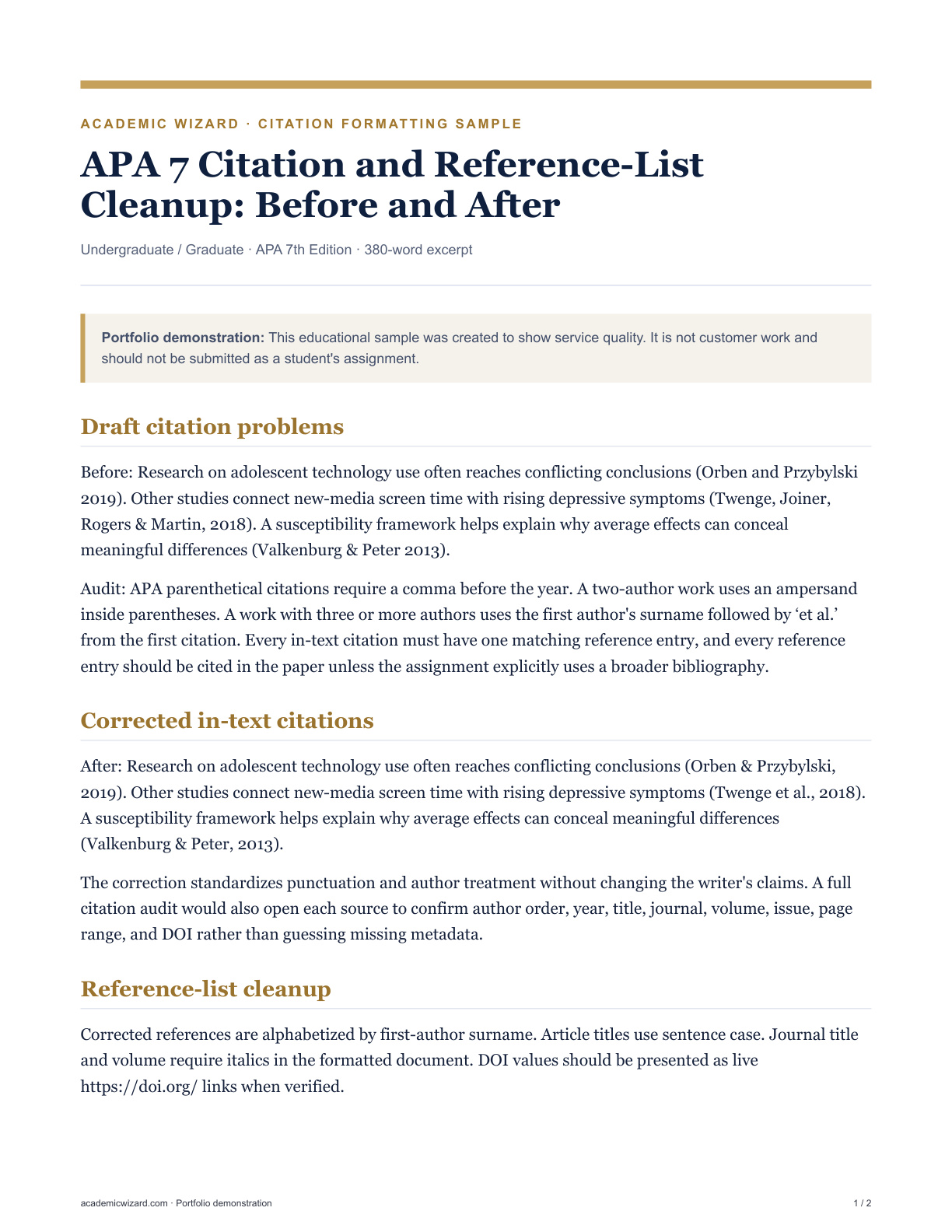
This sample demonstrates: In-text and reference-list matching, APA 7 author rules, sentence-case article titles, DOI normalization, alphabetization, and transparent notes about details that still require source verification.
Prepared by Academic Wizard · Hypothetical portfolio demonstration
380-word excerpt
Citation & Source Audit
Undergraduate / Graduate
APA 7th Edition
In-text and reference-list matching, APA 7 author rules, sentence-case article titles, DOI normalization, alphabetization, and transparent notes about details that still require source verification.
Portfolio demonstration · Educational illustration. Hypothetical, non-client material created to demonstrate the review method. It is not a completed assignment for submission. Customer files and deliverables are never published.
Flagship service walkthrough
From a common student need to a usable next step
Follow this illustrative, non-client example to see what Citation & Source Audit evaluates, what the evidence looks like, and what the defined deliverable contains.
A student's draft is substantially finished, but the in-text citations and reference list use inconsistent rules or no longer match one another.
A hypothetical APA 7 excerpt with missing year punctuation, incorrect multi-author treatment, inconsistent reference presentation, and source details that still require verification.
The Citation & Source Audit reconciles in-text citations with listed sources, applies the required style, checks core bibliographic fields, and separates verified corrections from missing details.
A cleaned-up document and review note covering citation matching, reference-list formatting, source-detail flags, and the remaining verification steps.
- Before-and-after in-text citations show the exact APA 7 author and punctuation corrections.
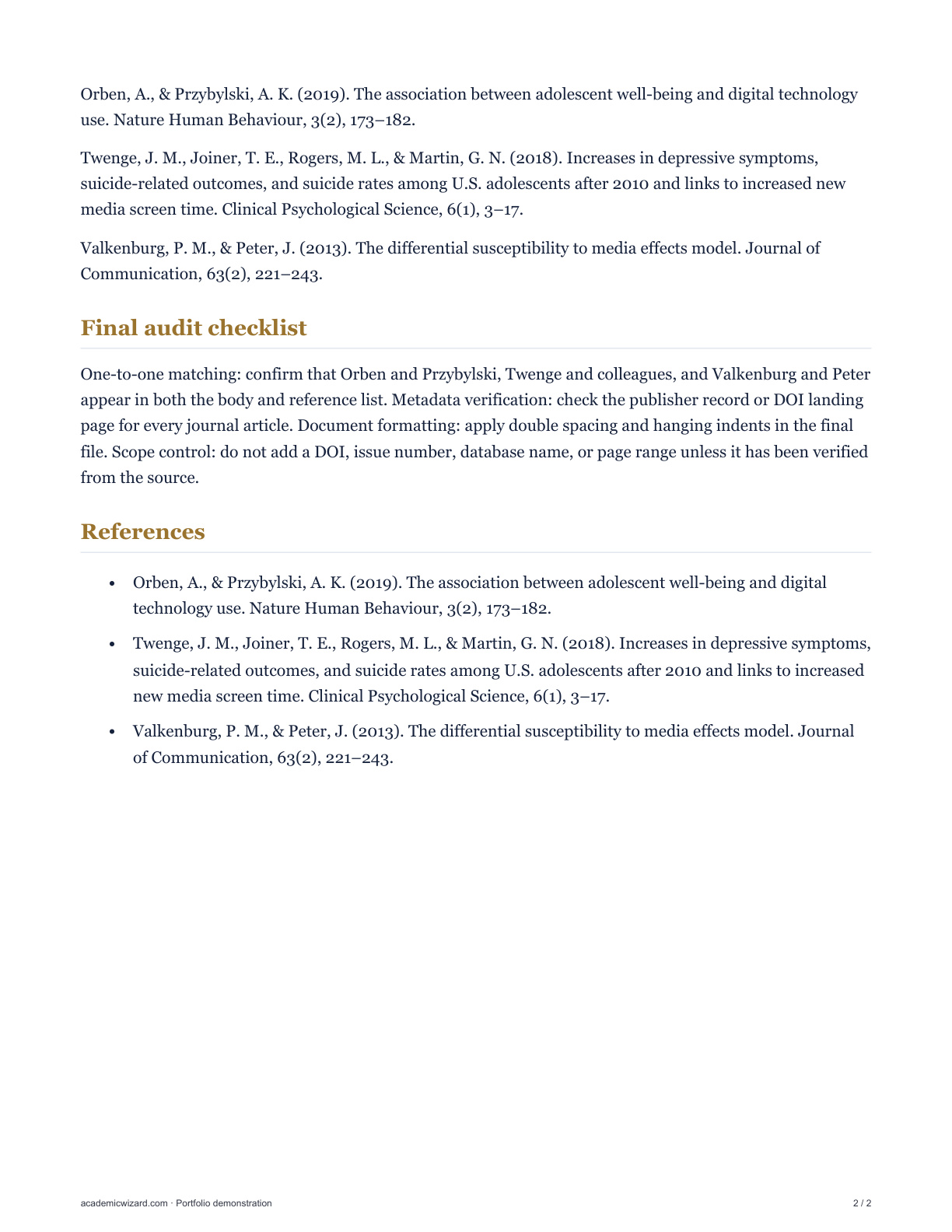
- The reference-list example demonstrates alphabetization, title case, journal formatting, and DOI presentation rules.
- The final checklist separates correctable style issues from metadata that must be confirmed from the source.
The service never invents authors, dates, page ranges, DOIs, URLs, or publication details. Unverifiable information is flagged for the student instead.
Review proof
Brief, reasoning, and final quality control
Hypothetical citation audit: reconcile in-text citations with the reference list and correct common APA 7 formatting errors.
- In-text/reference matching
- Author and date accuracy
- Entry formatting
- DOI and URL presentation
- Prioritized missing and unmatched sources because they create a larger integrity risk than punctuation errors.
- Standardized author, date, title, and container elements using APA rules.
- Separated verified corrections from items that require the student's source file.
- Every in-text citation has a reference
- Every reference is cited where required
- Core bibliographic fields checked
- Unverifiable details are flagged, not guessed
Draft citation problems
Before: Research on adolescent technology use often reaches conflicting conclusions (Orben and Przybylski 2019). Other studies connect new-media screen time with rising depressive symptoms (Twenge, Joiner, Rogers & Martin, 2018). A susceptibility framework helps explain why average effects can conceal meaningful differences (Valkenburg & Peter 2013).
Audit: APA parenthetical citations require a comma before the year. A two-author work uses an ampersand inside parentheses. A work with three or more authors uses the first author's surname followed by ‘et al.’ from the first citation. Every in-text citation must have one matching reference entry, and every reference entry should be cited in the paper unless the assignment explicitly uses a broader bibliography.
Corrected in-text citations
After: Research on adolescent technology use often reaches conflicting conclusions (Orben & Przybylski, 2019). Other studies connect new-media screen time with rising depressive symptoms (Twenge et al., 2018). A susceptibility framework helps explain why average effects can conceal meaningful differences (Valkenburg & Peter, 2013).
The correction standardizes punctuation and author treatment without changing the writer's claims. A full citation audit would also open each source to confirm author order, year, title, journal, volume, issue, page range, and DOI rather than guessing missing metadata.
Reference-list cleanup
Corrected references are alphabetized by first-author surname. Article titles use sentence case. Journal title and volume require italics in the formatted document. DOI values should be presented as live https://doi.org/ links when verified.
Orben, A., & Przybylski, A. K. (2019). The association between adolescent well-being and digital technology use. Nature Human Behaviour, 3(2), 173–182.
Twenge, J. M., Joiner, T. E., Rogers, M. L., & Martin, G. N. (2018). Increases in depressive symptoms, suicide-related outcomes, and suicide rates among U.S. adolescents after 2010 and links to increased new media screen time. Clinical Psychological Science, 6(1), 3–17.
Valkenburg, P. M., & Peter, J. (2013). The differential susceptibility to media effects model. Journal of Communication, 63(2), 221–243.
Final audit checklist
One-to-one matching: confirm that Orben and Przybylski, Twenge and colleagues, and Valkenburg and Peter appear in both the body and reference list. Metadata verification: check the publisher record or DOI landing page for every journal article. Document formatting: apply double spacing and hanging indents in the final file. Scope control: do not add a DOI, issue number, database name, or page range unless it has been verified from the source.
References
- Orben, A., & Przybylski, A. K. (2019). The association between adolescent well-being and digital technology use. Nature Human Behaviour, 3(2), 173–182.
- Twenge, J. M., Joiner, T. E., Rogers, M. L., & Martin, G. N. (2018). Increases in depressive symptoms, suicide-related outcomes, and suicide rates among U.S. adolescents after 2010 and links to increased new media screen time. Clinical Psychological Science, 6(1), 3–17.
- Valkenburg, P. M., & Peter, J. (2013). The differential susceptibility to media effects model. Journal of Communication, 63(2), 221–243.
Get the Final QA Checklist
Use the same evidence-first review order demonstrated in Academic Wizard's public samples.
The requested resource is sent even if you leave optional marketing unchecked. Privacy Policy applies.
Sample questions
What this example is—and how to use it
What does this Citation & Source Audit sample demonstrate?
In-text and reference-list matching, APA 7 author rules, sentence-case article titles, DOI normalization, alphabetization, and transparent notes about details that still require source verification.
Is this real student or client work?
No. Academic Wizard created this hypothetical portfolio sample to demonstrate a defined service while protecting student privacy and avoiding fabricated testimonials.
Can I submit this sample as my own work?
No. Use the sample to understand structure, review scope, and deliverable quality. Your submission must remain your own work and follow your institution's rules.
Keep learning
Related service, guide, and tools
More sample deliverables
Ready when you are
Get structured support on your next assignment
Choose the defined expert service that fits your student-authored work, or use the free Assignment Control Center for planning.
Want to compare every expert option? Browse Expert Help or view pricing