
Paper Audit
Financial Literacy Argument Draft
This sample demonstrates: A bounded diagnostic report connecting a student-authored draft to the rubric, identifying strengths, and ranking revision priorities without rewriting.
Prepared by Academic Wizard · Hypothetical portfolio demonstration
Demonstration audit report
Paper Audit
Undergraduate
MLA 9th Edition
A bounded diagnostic report connecting a student-authored draft to the rubric, identifying strengths, and ranking revision priorities without rewriting.
Portfolio demonstration · Educational illustration. Hypothetical, non-client material created to demonstrate the review method. It is not a completed assignment for submission. Customer files and deliverables are never published.
Flagship service walkthrough
From a common student need to a usable next step
Follow this illustrative, non-client example to see what Paper Audit evaluates, what the evidence looks like, and what the defined deliverable contains.
A student has a complete draft and one rubric but cannot tell which problems matter most or what to revise first before submission.
A hypothetical undergraduate financial-literacy argument with a clear position, a strong equity section, uneven evidence placement, and unresolved MLA citation risks.
The Paper Audit checks rubric alignment, thesis, structure, evidence placement, source use, citation risk, and clarity, then ranks the work instead of rewriting it.
A written diagnosis, supported strengths, rubric findings, prioritized revision plan, citation-risk checklist, and clear next actions.
- The audit identifies the equity argument as the strongest section instead of presenting only criticism.
- Rubric findings separate what already aligns from the evidence and feasibility gaps that remain.
- A five-step revision plan turns broad feedback into an ordered set of student actions.
The student revises the paper. The audit produces no replacement prose, invents no sources, and keeps every recommendation tied to the hypothetical draft and rubric.
Review proof
Brief, reasoning, and final quality control
Hypothetical undergraduate Paper Audit: evaluate a student-authored argument draft against one rubric and identify the highest-priority revisions without rewriting it.
- Rubric alignment
- Thesis and structure
- Evidence placement
- Citation-system risk
- Converted broad feedback into a ranked revision sequence so the student can act on it.
- Separated supported strengths from unresolved evidence risks.
- Recommended a next service only where the remaining work fits its defined scope.
- Report stays within diagnostic scope
- No replacement prose is produced
- Recommendations connect to the hypothetical rubric
- Citation risks are flagged without inventing source details
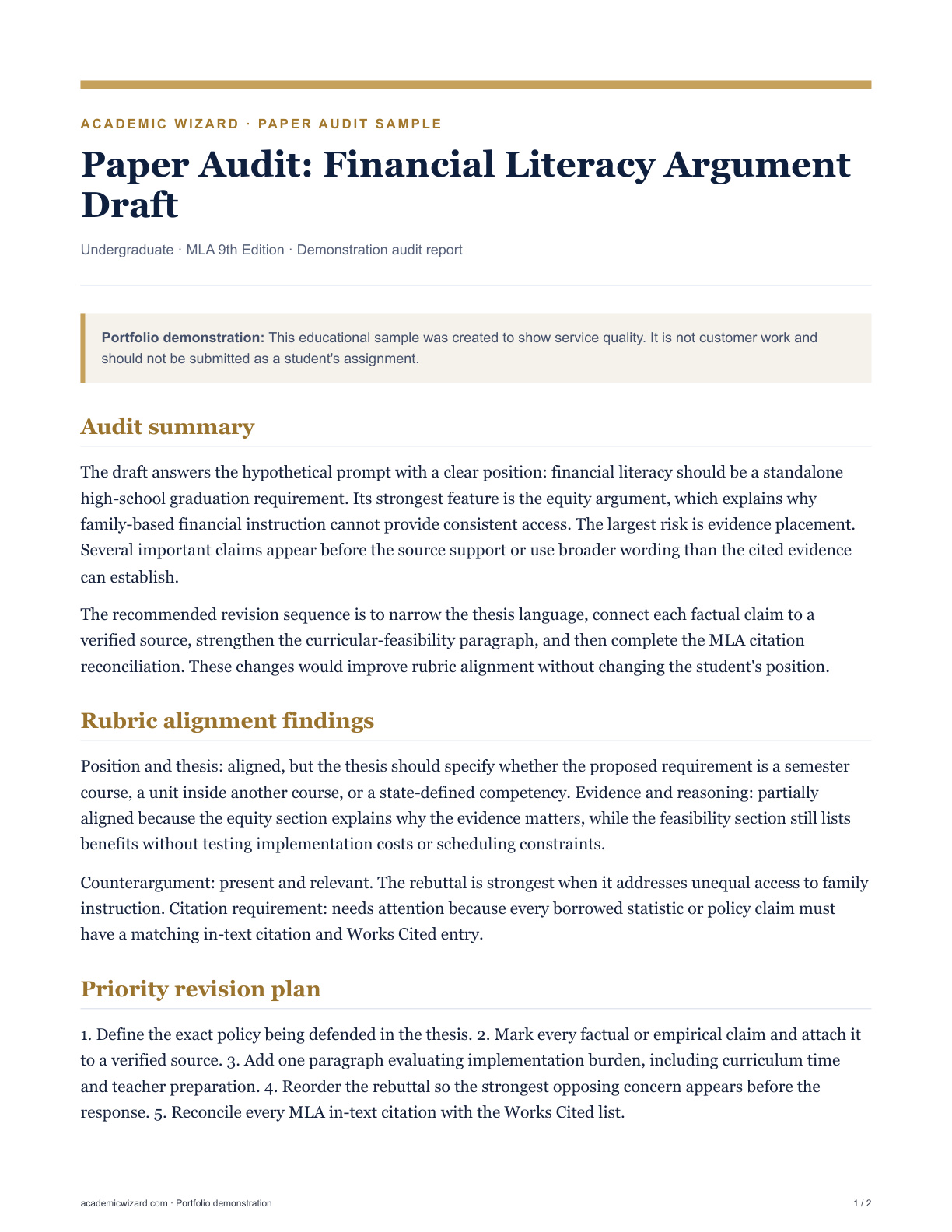
Audit summary
The draft answers the hypothetical prompt with a clear position: financial literacy should be a standalone high-school graduation requirement. Its strongest feature is the equity argument, which explains why family-based financial instruction cannot provide consistent access. The largest risk is evidence placement. Several important claims appear before the source support or use broader wording than the cited evidence can establish.
The recommended revision sequence is to narrow the thesis language, connect each factual claim to a verified source, strengthen the curricular-feasibility paragraph, and then complete the MLA citation reconciliation. These changes would improve rubric alignment without changing the student's position.
Rubric alignment findings
Position and thesis: aligned, but the thesis should specify whether the proposed requirement is a semester course, a unit inside another course, or a state-defined competency. Evidence and reasoning: partially aligned because the equity section explains why the evidence matters, while the feasibility section still lists benefits without testing implementation costs or scheduling constraints.
Counterargument: present and relevant. The rebuttal is strongest when it addresses unequal access to family instruction. Citation requirement: needs attention because every borrowed statistic or policy claim must have a matching in-text citation and Works Cited entry.
Priority revision plan
1. Define the exact policy being defended in the thesis. 2. Mark every factual or empirical claim and attach it to a verified source. 3. Add one paragraph evaluating implementation burden, including curriculum time and teacher preparation. 4. Reorder the rebuttal so the strongest opposing concern appears before the response. 5. Reconcile every MLA in-text citation with the Works Cited list.
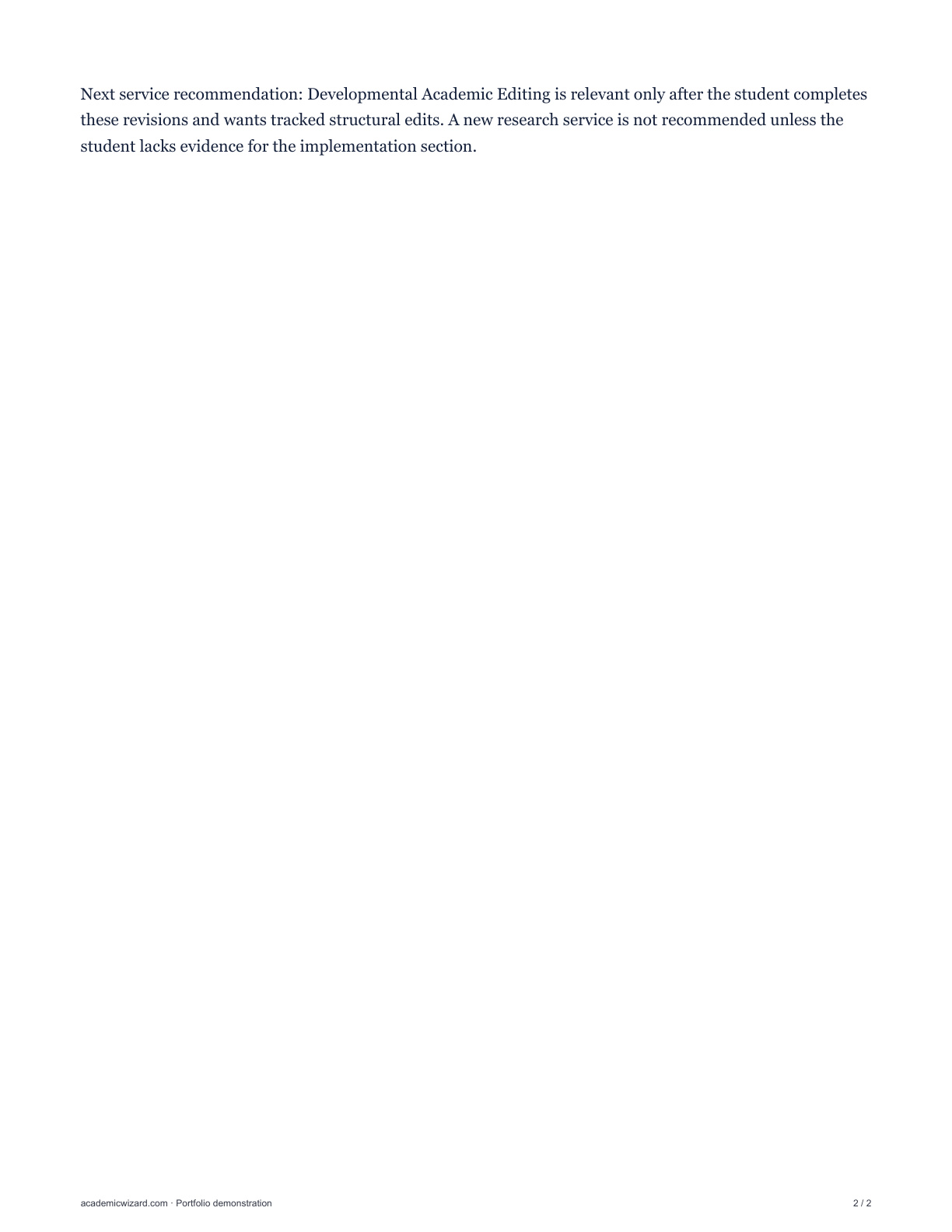
Next service recommendation: Developmental Academic Editing is relevant only after the student completes these revisions and wants tracked structural edits. A new research service is not recommended unless the student lacks evidence for the implementation section.
Citation-risk checklist
Verify the source behind every statistic, policy claim, and statement about student outcomes. Confirm that each borrowed idea has an MLA in-text citation and that every in-text citation maps to one complete Works Cited entry. Do not add a DOI, date, author, page number, or publication detail that is not present in the source material.
Highest-risk locations: the opening claim about financial knowledge, the state-requirement comparison, and the implementation-cost paragraph. These claims should be checked before sentence-level polishing because unsupported evidence can change the strength and wording of the argument.
Revision timeline and quality-control confirmation
First pass: narrow the thesis and mark evidence gaps. Second pass: revise the implementation and rebuttal sections. Final pass: reconcile citations, read the paper against the rubric, and confirm that the conclusion matches the revised policy claim.
Audit scope confirmed: up to five student-authored pages plus one rubric. Checked: rubric alignment, thesis and structure, evidence placement, source-use and citation risks, and prioritized next actions. No sentences were rewritten and no sources or assignment content were invented.
Get the Final QA Checklist
Use the same evidence-first review order demonstrated in Academic Wizard's public samples.
The requested resource is sent even if you leave optional marketing unchecked. Privacy Policy applies.
Sample questions
What this example is—and how to use it
What does this Paper Audit sample demonstrate?
A bounded diagnostic report connecting a student-authored draft to the rubric, identifying strengths, and ranking revision priorities without rewriting.
Is this real student or client work?
No. Academic Wizard created this hypothetical portfolio sample to demonstrate a defined service while protecting student privacy and avoiding fabricated testimonials.
Can I submit this sample as my own work?
No. Use the sample to understand structure, review scope, and deliverable quality. Your submission must remain your own work and follow your institution's rules.
Keep learning
Related service, guide, and tools
More sample deliverables
Ready when you are
See what your own paper needs next
A $39 Paper Audit reviews up to five student-authored pages and one rubric, then gives you a prioritized revision plan.
Want to compare every expert option? Browse Expert Help or view pricing