
Research Blueprint
Remote Work and Urban Commercial Real Estate: An Emerging Research Framework
This sample demonstrates: A hypothetical question-coaching path, student-confirmed scope, thesis decision checklist, methodological foreshadowing, and structured outline anchored to real data sources.
Prepared by Academic Wizard · Hypothetical portfolio demonstration
866 words
Research Blueprint
Upper-Division Undergraduate / Early Graduate
APA 7th Edition
A hypothetical question-coaching path, student-confirmed scope, thesis decision checklist, methodological foreshadowing, and structured outline anchored to real data sources.
Portfolio demonstration · Educational illustration. Hypothetical, non-client material created to demonstrate the review method. It is not a completed assignment for submission. Customer files and deliverables are never published.
Flagship service walkthrough
From a common student need to a usable next step
Follow this illustrative, non-client example to see what Research Blueprint evaluates, what the evidence looks like, and what the defined deliverable contains.
A student has a broad research topic but no focused question, workable outline, or reliable plan for finding and using evidence.
A hypothetical remote-work topic with several possible directions, mixed source types, and no defined boundary between market evidence, policy analysis, and scholarly context.
The Research Blueprint reviews the working question, explains the scope choices, and—after the student confirms the direction—maps each section and evidence need into a responsible source-search and drafting plan.
A question-coaching report, student-confirmed scope, section-by-section outline, database and search-term direction, evidence-category plan, and practical drafting roadmap.
- The question separates structural change from short-term market fluctuation.
- The outline moves from background to market evidence, policy response, limitations, and future research.
- The source plan distinguishes current market reports from scholarly frameworks instead of treating every source as interchangeable.
This is a hypothetical demonstration. In a real blueprint, the student chooses the final question, verifies sources, conducts the research, and writes the submission.
Review proof
Brief, reasoning, and final quality control
Hypothetical research-planning demonstration: review a working question, show the scope decisions, and build a section outline and source direction on remote work and urban office demand.
- Research-question feasibility
- Student-owned thesis decision points
- Section sequence
- Source-plan relevance
- Explained how separating structural change from short-term market fluctuation creates a researchable tension.
- Marked the qualified thesis as a demonstration of the decision structure, not wording for a student's submission.
- Sequenced background, disruption, policy response, and future research to prevent a purely descriptive paper.
- Question is specific and researchable
- Outline sections answer the question
- Source plan includes data and scholarship
- No sources or findings are invented
Opening
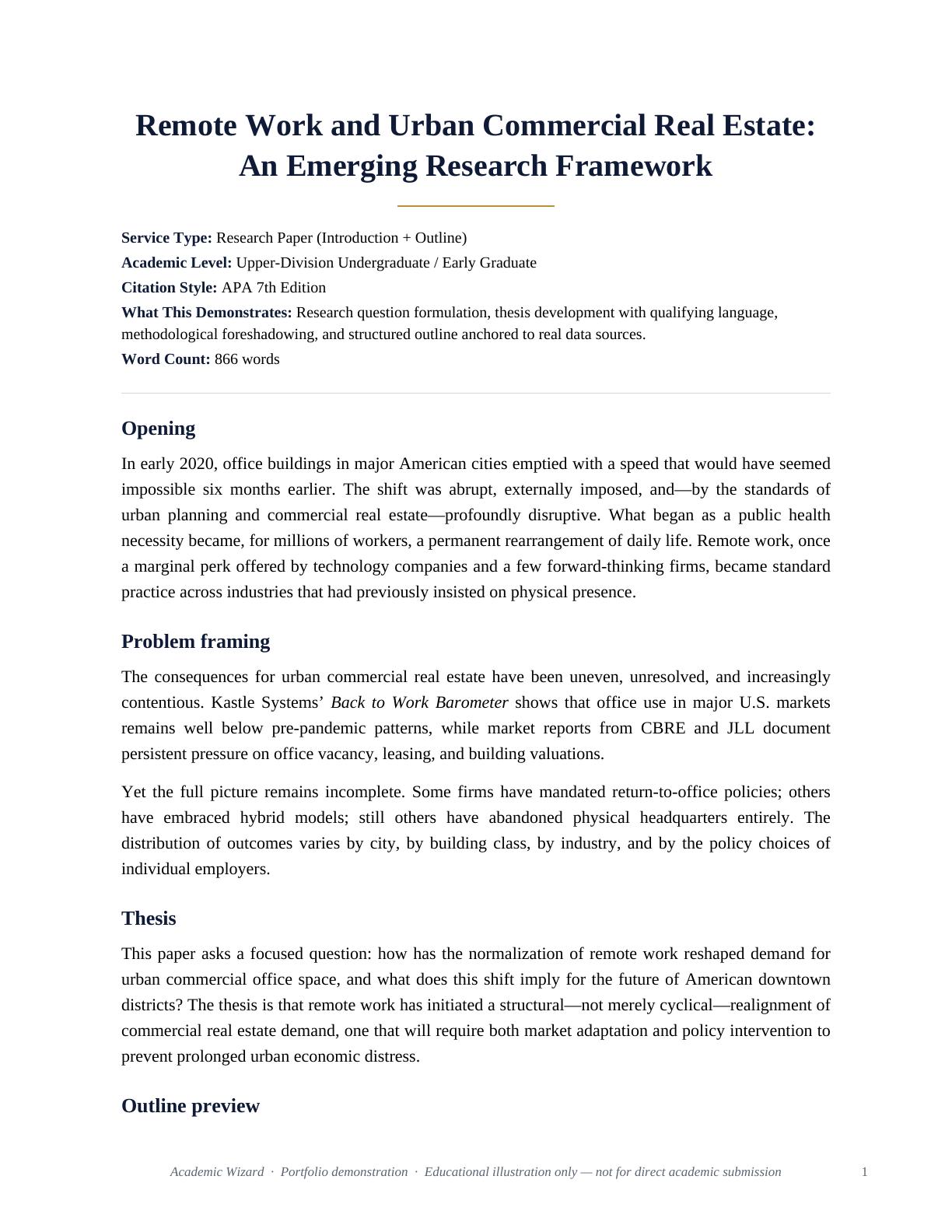
In early 2020, office buildings in major American cities emptied with a speed that would have seemed impossible six months earlier. The shift was abrupt, externally imposed, and—by the standards of urban planning and commercial real estate—profoundly disruptive. What began as a public health necessity became, for millions of workers, a permanent rearrangement of daily life. Remote work, once a marginal perk offered by technology companies and a few forward-thinking firms, became standard practice across industries that had previously insisted on physical presence.
Problem framing
The consequences for urban commercial real estate have been uneven, unresolved, and increasingly contentious. Kastle Systems' Back to Work Barometer shows that office use in major U.S. markets remains well below pre-pandemic patterns, while market reports from CBRE and JLL document persistent pressure on office vacancy, leasing, and building valuations.
Yet the full picture remains incomplete. Some firms have mandated return-to-office policies; others have embraced hybrid models; still others have abandoned physical headquarters entirely. The distribution of outcomes varies by city, by building class, by industry, and by the policy choices of individual employers.
Thesis
This paper asks a focused question: how has the normalization of remote work reshaped demand for urban commercial office space, and what does this shift imply for the future of American downtown districts? The thesis is that remote work has initiated a structural—not merely cyclical—realignment of commercial real estate demand, one that will require both market adaptation and policy intervention to prevent prolonged urban economic distress.
Outline preview
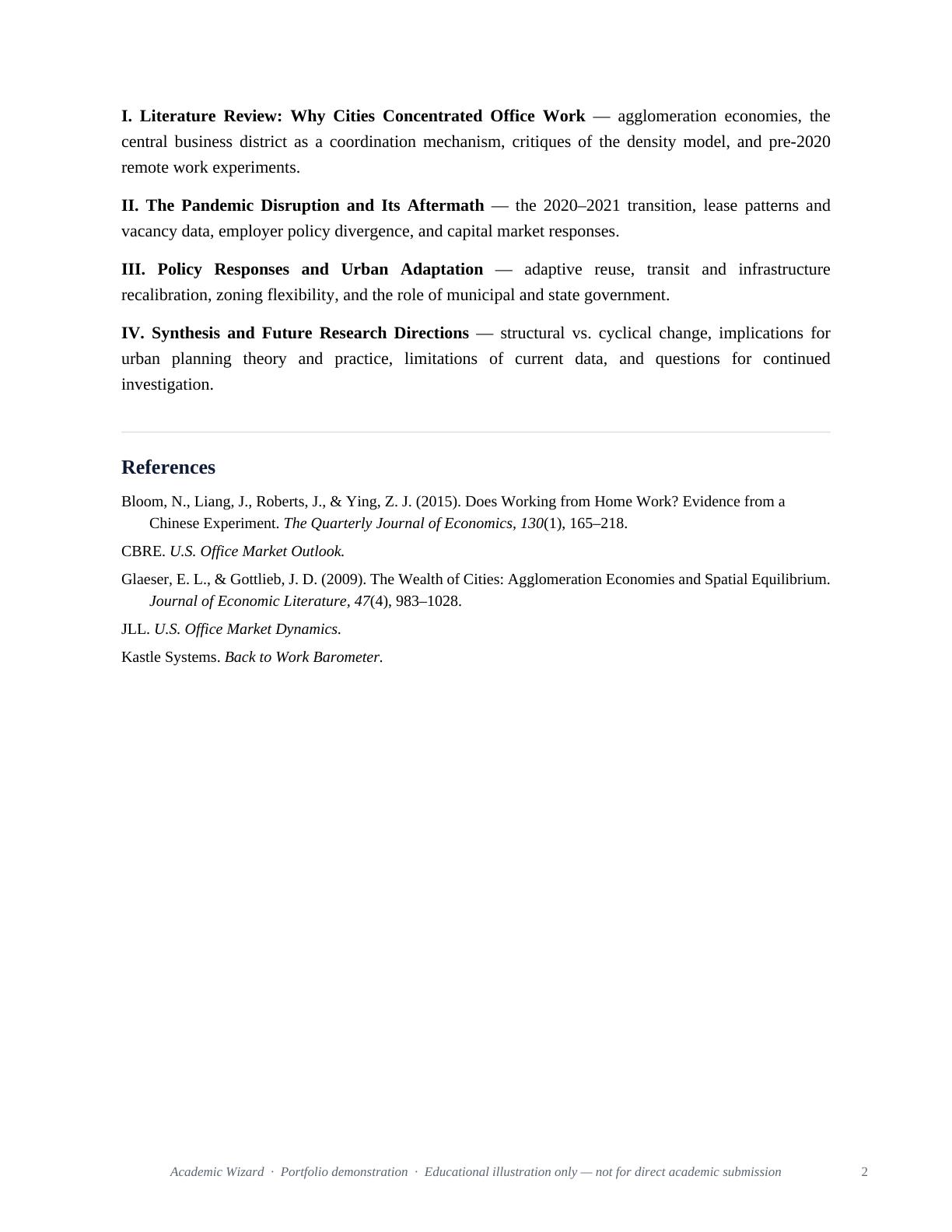
I. Literature Review: Why Cities Concentrated Office Work — agglomeration economies, the central business district as a coordination mechanism, critiques of the density model, and pre-2020 remote work experiments.
II. The Pandemic Disruption and Its Aftermath — the 2020–2021 transition, lease patterns and vacancy data, employer policy divergence, and capital market responses.
III. Policy Responses and Urban Adaptation — adaptive reuse, transit and infrastructure recalibration, zoning flexibility, and the role of municipal and state government.
IV. Synthesis and Future Research Directions — structural vs. cyclical change, implications for urban planning theory and practice, limitations of current data, and questions for continued investigation.
References
- Kastle Systems. Back to Work Barometer.
- CBRE. U.S. Office Market Outlook.
- JLL. U.S. Office Market Dynamics.
- Glaeser, E. L., & Gottlieb, J. D. (2009). The Wealth of Cities: Agglomeration Economies and Spatial Equilibrium. Journal of Economic Literature, 47(4), 983–1028.
- Bloom, N., Liang, J., Roberts, J., & Ying, Z. J. (2015). Does Working from Home Work? Evidence from a Chinese Experiment. The Quarterly Journal of Economics, 130(1), 165–218.
Get the Final QA Checklist
Use the same evidence-first review order demonstrated in Academic Wizard's public samples.
The requested resource is sent even if you leave optional marketing unchecked. Privacy Policy applies.
Sample questions
What this example is—and how to use it
What does this Research Blueprint sample demonstrate?
A hypothetical question-coaching path, student-confirmed scope, thesis decision checklist, methodological foreshadowing, and structured outline anchored to real data sources.
Is this real student or client work?
No. Academic Wizard created this hypothetical portfolio sample to demonstrate a defined service while protecting student privacy and avoiding fabricated testimonials.
Can I submit this sample as my own work?
No. Use the sample to understand structure, review scope, and deliverable quality. Your submission must remain your own work and follow your institution's rules.
Keep learning
Related service, guide, and tools
More sample deliverables
Ready when you are
Get structured support on your next assignment
Choose the defined expert service that fits your student-authored work, or use the free Assignment Control Center for planning.
Want to compare every expert option? Browse Expert Help or view pricing