
Research Planning & Editing
Research Planning & Editing: Remote Work Draft Review
This sample demonstrates: Research-question refinement, evidence mapping, source-integration feedback, and tracked editorial reasoning applied to a student-authored draft.
Prepared by Academic Wizard · Hypothetical portfolio demonstration
Demonstration review and edit report
Research Planning & Editing
Upper-Division Undergraduate
APA 7th Edition
Research-question refinement, evidence mapping, source-integration feedback, and tracked editorial reasoning applied to a student-authored draft.
Portfolio demonstration · Educational illustration. Hypothetical, non-client material created to demonstrate the review method. It is not a completed assignment for submission. Customer files and deliverables are never published.
Review proof
Brief, reasoning, and final quality control
Hypothetical research-planning and editing review: refine a student-authored question, map evidence needs, and explain structural edits to a developing draft.
- Research-question scope
- Evidence map
- Source integration
- Section sequence and editorial clarity
- Narrowed the comparison to a feasible geography and time period.
- Separated market data, policy evidence, and scholarship so each source category has a clear job.
- Reordered background and analysis to make the research logic visible.
- Student retains authorship
- Question is feasible and specific
- Suggested evidence is not presented as verified fact
- Every structural change has a stated reason
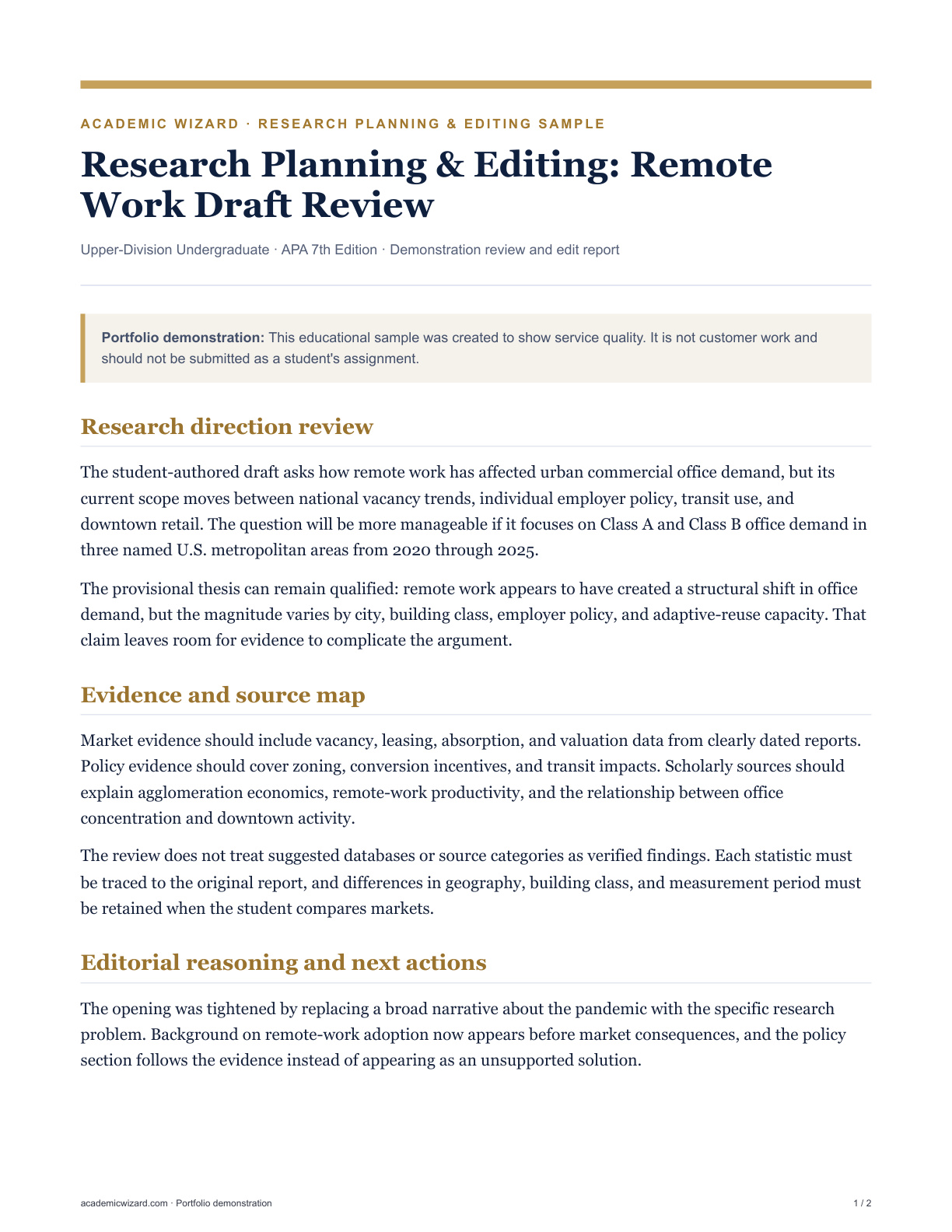
Research direction review
The student-authored draft asks how remote work has affected urban commercial office demand, but its current scope moves between national vacancy trends, individual employer policy, transit use, and downtown retail. The question will be more manageable if it focuses on Class A and Class B office demand in three named U.S. metropolitan areas from 2020 through 2025.
The provisional thesis can remain qualified: remote work appears to have created a structural shift in office demand, but the magnitude varies by city, building class, employer policy, and adaptive-reuse capacity. That claim leaves room for evidence to complicate the argument.
Evidence and source map
Market evidence should include vacancy, leasing, absorption, and valuation data from clearly dated reports. Policy evidence should cover zoning, conversion incentives, and transit impacts. Scholarly sources should explain agglomeration economics, remote-work productivity, and the relationship between office concentration and downtown activity.
The review does not treat suggested databases or source categories as verified findings. Each statistic must be traced to the original report, and differences in geography, building class, and measurement period must be retained when the student compares markets.
Editorial reasoning and next actions
The opening was tightened by replacing a broad narrative about the pandemic with the specific research problem. Background on remote-work adoption now appears before market consequences, and the policy section follows the evidence instead of appearing as an unsupported solution.
Next actions: lock the three comparison cities, verify consistent market metrics, draft one evidence table, revise the methods paragraph to explain comparison limits, and then check that every source-based claim has an APA in-text citation and matching reference entry.

Get the Final QA Checklist
Use the same evidence-first review order demonstrated in Academic Wizard's public samples.
The requested resource is sent even if you leave optional marketing unchecked. Privacy Policy applies.
Sample questions
What this example is—and how to use it
What does this Research Planning & Editing sample demonstrate?
Research-question refinement, evidence mapping, source-integration feedback, and tracked editorial reasoning applied to a student-authored draft.
Is this real student or client work?
No. Academic Wizard created this hypothetical portfolio sample to demonstrate a defined service while protecting student privacy and avoiding fabricated testimonials.
Can I submit this sample as my own work?
No. Use the sample to understand structure, review scope, and deliverable quality. Your submission must remain your own work and follow your institution's rules.
Keep learning
Related service, guide, and tools
More sample deliverables
Ready when you are
Get structured support on your next assignment
Choose the defined expert service that fits your student-authored work, or use the free Assignment Control Center for planning.
Want to compare every expert option? Browse Expert Help or view pricing